New York City’s oldest library refreshes its historic home
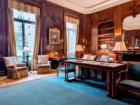
The Members’ Room at the New York Society Library Courtesy the New York Society Library
Since its establishment in 1754, the New York Society Library has sought to put books into the hands of readers. That mission was pioneering in an era that predated the taxpayer-funded public library system. Membership fees have supported the growth of what is now New York City’s oldest library—including after its books were looted under the British occupation of Manhattan during the American Revolutionary War—into the 21st century.
“When we were founded, we were providing the citizens of New York with information about the Enlightenment and Enlightenment ideals,” Carolyn Waters, the library’s director and head librarian, tells The Art Newspaper. “We were closed during the revolution, and when we reopened in 1789, we served all the members of the new government: George Washington, John Adams, Alexander Hamilton, John Jay, Aaron Burr. They all took books out of our library.”
When the library’s first building-wide renovation project since the 1980s started in 2024, maintaining and improving that access was essential. Although only members can check out materials, anyone can use the collection for reading and research. On a recent visit to tour the completed renovation work, Waters shared how the library stayed open while its 12-level stacks were expanded, reading and study rooms for members added, and a conservation lab created to care for its roughly 300,000 volumes maintained as a largely circulating collection.
The library’s new conservation lab Photo: Phillip Reed / Reed Photographic
“We have a lot of stuff that has long since been weeded out of other collections, so we may have one of the only copies, and certainly one of the only circulating copies, because while a lot of these books are probably at the New York Public Library or Princeton University, you would have to request them,” Waters says. “We let you check them out. That’s another reason why some of our books are in such bad shape, because they have been loved to death. But what’s the use of a pristine book, right?”
The book conservator Werner Haun was then preparing a first edition of Thomas Paine’s pamphlet Common Sense for the library’s Collective Witness: A Library for a Young Country exhibition that opened on 18 June and showcases its 18th-century materials. Often, the books being repaired are treated and put back on the shelves. The library has been in its Italianate townhouse home on the Upper East Side’s 79th Street since 1937, and as it acquires new books each year, its stacks became packed, and some volumes were relocated to off-site storage.
“We moved as the city was moving northward, and we kept outgrowing all of our locations,” Waters says. “It was important for us to figure out how to work with this building. We were bursting at the seams, but we really didn’t want to move. We serve people from all over the city and beyond, but we’re primarily a neighbourhood library.”
The renovation project, led by Larson Architecture Works, opened more space to have these materials on site while also expanding the popular member spaces. On a recent weekday morning, nearly every desk and table was occupied, even in what is known as the Green Alcove nestled deep in the stacks—its panelling salvaged from the library’s former home at University Place.
The new Henry S.F. Cooper Jr. Room for member reading and study Photo: Phillip Reed / Reed Photographic
“Carolyn kept saying: ‘My biggest problem is space for people,’” says the architect Douglas E. Larson. “People join because they want to come here and work in a quiet environment. Some don’t even go to the stacks. They just go there and write. So, people were really using it as a community space.”
The renovation was conducted in phases, with an unused rear yard transformed into book storage for folios and semi-rare books. The previously staff-only fourth floor was reconfigured with a study and events space, as well as the conservation studio and a rare-books reading room. Most dramatically, new staff offices were created on a lower level, opening a lobby-level stacks area.
“It was like those puzzle games with the squares that you slide around with your thumbs,” Larson says. “You make one empty space, and you slide another part into it.”
Alterations to the spaces were simple and subtle, with glass partitions for new offices harmonising with the walnut panelling and sculpted fireplace mantels. Added bookcases were matched to the historical designs. Although little has radically changed, these improvements will allow the New York Society Library to continue to add to its collection and endure as an urban haven of calm. As Waters observes: “Despite the fact that we’ve been around for 272 years, we’re still under the radar.”