âItâs beautiful and sad to be a human beingâ: Ragnar Kjartansson brings âthe best artwork of the 21st centuryâ to Australia
A nine-screen installation with a cult following is one of many highlights in the Icelandic artistâs first major Australian show, at Melbourneâs NGV
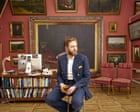
In a video recorded by Icelandic artist Ragnar Kjartansson, he stands side by side with his mother, Guðrún Ãsmundsdóttir, in front of a bookshelf, as if posing for a photo. Ãsmundsdóttir was 65 at the time and appears with a halo of greying curls, wearing a red cardigan. She looks up at her smartly dressed son, then repeatedly, noisily, spits into his face. âI wanted to make a brutal work,â says Kjartansson of the video, which he made in 2000 while at art school in ReykjavÃk. He almost succeeded. For most of it, Kjartansson mutely accepts the abuse from his stony-faced mother. Occasionally, though, the pair dissolve into laughter.
Every five years, Kjartansson and Ãsmundsdóttir have restaged the piece. As the videos progress, you witness both mother and son ageing. The latest of the six instalments was filmed in 2025, the year Ãsmundsdóttir turned 90. âShe almost canât spit any more. Itâs very hard for her,â says Kjartansson.
The work almost didnât develop into this modern-day memento mori. A guest lecturer told him the first recording was a âfailureâ because âyou see that you are pretendingâ; it didnât help that, in Iceland, Ãsmundsdóttir is a well-known actor.
Kjartansson, who is quick to laugh and thoughtful in conversation, remembers being âheartbrokenâ by the feedback. âBut then I became very thankful for what he told me because it became the essence of my works: working with this reality that is pretend. When you are on stage, pretending, it is still reality.â
Ever since, Kjartansson has devised performances that have deftly blurred authenticity and performativity, irony and sincerity, and comedy and tragedy. Some of them exist only in the moment, in front of an audience; others are captured in drawings, paintings and, most famously, on video.
Eight of Kjartanssonâs enthralling video works, including Me and My Mother, are on show at the National Gallery of Victoria. Mercy is the artistâs first major solo exhibition in Australia, but his work has been exhibited to acclaim around the globe â and in 2019, the Guardian named his nine-screen video installation The Visitors as the best artwork of the 21st century.
That 64-minute-long work was filmed in one take on Rokeby Farm, a dilapidated Gilded Age mansion in upstate New York. Each screen shows a single musician performing in their own room. Unable to see each other, they play their individual parts of a haunting, looping song that builds to a moment of catharsis. It is often described as a reflection on the breakdown of Kjartanssonâs first marriage, which it is, though it is also much more than that: a âlove songâ to the United States, a celebration of friendship and a tribute to the magnificent, crumbling house itself.
The Visitors, which made its Australian premiere in Perth in 2015, has developed a cult following matched by few other contemporary artworks. Multiple bootleg recordings of it have been uploaded to YouTube, one of which has been watched more than 340,000 times. In the more than 1,000 comments, dozens of people recall how it brought them to tears, some joyful, others sad.
These mixed responses reflect Kjartanssonâs gift for expressing an idea his father, theatre director and playwright Kjartan Ragnarsson, imparted one Christmas, when Kjartansson was in his early 20s. âMy dad was drunk, we were smoking cigars and drinking cognac,â recalls Kjartansson, smiling at the memory. âHe said, âMy son, I will teach you the most important lesson in life: itâs beautiful and sad to be a human being.ââ
This sentiment resonates in The Visitors and throughout the NGV show. Music is the emotional anchor in most of the works, with repeating lyrics and melodies often lulling visitors into a shared, almost hypnotic experience. Behind Kjartanssonâs mesmerising performances are a dizzying array of musical influences, among them Elvis, Abba, Mozart and, in his most recent piece, Sunday Without Love, a German comedy song from 1996.
Bringing Kjartanssonâs musical chimeras to life are a trusted cast and crew. Regular collaborators include members of the Icelandic bands Sigur Rós and Múm, who were among the musicians that played in The Visitors; American musicians Aaron and Bryce Dessner, founders of the National and Taylor Swift collaborators; and Ingibjörg Sigurjónsdóttir, Kjartanssonâs wife and a fellow artist. Kjartanssonâs videos also reference paintings, films, plays (particularly the work of Anton Chekhov) and politics. The Visitors is imbued with the optimism of the Obama years, when it was made. More recent pieces are darker. Scenes from Western Culture depicts a series of idyllic but uneventful moments: a couple having dinner in an upmarket restaurant, a woman swimming laps in a private pool, children playing in a garden. The videos showcase undeniably comfortable lives, but their mundanity also hints at a malaise.
The work was inspired by Kjartanssonâs observation that, wherever he travelled, he saw the same shops, ate the same food and heard the same songs on the radio, including on his one previous trip to Australia. âI was surprised how similar it is,â he says. âYou travel as far as you can go, but itâs the same cafe as ReykjavÃk.â
The exhibition ends with No Tomorrow, a pared-back work featuring eight dancers moving around a gleaming, empty stage. Rehearsals began as Donald Trump started his first presidency. The work is about ânothing[ness] and beautyâ, says Kjartansson. He paraphrases the American artist Agnes Martin: âAll art is about beauty. Itâs either a celebration of the beauty of the world or a demonstration against the lack of beauty in the world.â
Kjartanssonâs concern over global politics played into the exhibitionâs title, Mercy. âThereâs grace in the world and thereâs also violence in the world. I like that double edge. It also has that sense of religiousness. Being in Nick Caveâs city, I want to be biblical.â
Like Melbourneâs prince of darkness, Kjartansson uses the mechanics of religious rites to create meaning, or even inspire transcendence. The repetition of lyrics and movements in his videos, sometimes for hours on end, makes them feel like prayers. Performed often enough, seemingly simple phrases or gestures transform into acts of devotion.
Perhaps Kjartanssonâs most ritualistic work is Me and My Mother. A work that was envisaged as brutal, then became comic, is now a meditation on ageing, family and the lengths we will go to for love. Again and again, Ãsmundsdóttir joins her son in this bizarre ceremony, even as it becomes visibly difficult for her. In the process, something absurd becomes profound.
Ragnar Kjartansson: Mercy is at the National Gallery of Victory from 26 June to 4 October. Ragnar will be speaking at the exhibition at 3.30pm on Saturday 27 June