Ali Khameneiâs six-day funeral expected to draw millions in Iran
Huge scale of funeral for supreme leader across five cities is intended to relay message of resistance to rest of the world
In the small hours of Friday the police roadblocks, stalls, posters and army vans were starting to appear across Tehran as millions of Iranians prepared to attend the long-delayed six-day funeral ceremony for Ali Khameneiâs, Iranâs supreme leader for 36 turbulent years.
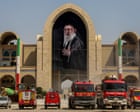
Killed in the opening salvo of the US-Israeli attack on the country in February, the funeral is intended to be an epic display of personal mourning, national power, resilience and social cohesion. Small groups of mourners carrying flags were gathering along the roads festooned with the red fist, the symbol of the funeral alongside the slogan âWe must riseâ. At a ceremony dedicated to the families of martyrs, Khameneiâs coffin was displayed.
Iranâs first vice-president, Mohammad Reza Aref, who is the lead funeral organiser, described the ceremony, which begins on Saturday in Tehran and will end with Khameneiâs burial on Thursday in Mashhad, as âthe most important event of this centuryâ and the most attended event since the 1979 revolution.
The funeralâs scale has been conceived to relay political and religious messages of resistance to the rest of the world. The former supreme leaderâs body, at the request of Iraqi politicians, will also be carried through the Iraqi Shia cities of Karbala and Najaf.
Despite the many posters of Khameneiâs son and successor, Mojtaba Khamenei, walking with his father in a garden, projecting continuity, Mojtaba is not expected to make an appearance at his fatherâs funeral. He was severely injured in the same US-Israeli strike on a government residence in Tehran at a little after 8am local time on 28 February that killed many of his family. It killed Ali Khamenei, his daughter and her husband, Mojtabaâs wife and his 14-month-old daughter.
The extent of Mojtabaâs injuries are unknown and he has so far issued only written statements, including one that distanced himself from the ceasefire negotiations, but sanctioned their continuance. Israelâs defence minister Israel Katz threatened to kill him this week, saying he was marked for death, remarks that prompted hardliners to call for a re-examination of Iranâs fatwa against possession of nuclear weapons.
Mohammad Bagher Ghalibaf, Iranâs chief negotiator and speaker of the still suspended parliament, said in an eve-of-funeral message: âWe must rise up and convey the nationâs call for bloodshed to the world so that the world knows that the honourable and noble nation of Iran will not remain silent in the face of oppression and arrogance and will not spare the blood of its imam.
âIran stands on the threshold of creating one of the greatest scenes in its history, a day when a nation, with hearts full of love, loyalty and the pain of separation, comes to bid farewell to a great man.â
The public funeral will begin on Saturday â as the US marks the 250th anniversary of its declaration of independence â at Tehranâs Grand Mosalla mosque, where Khameneiâs body will lie in state alongside the bodies of his relatives. The vast mosque complex has hosted many state religious ceremonies.
All week, workers have been redecorating the vast building and there has been a heavy police presence around the area. The funeral had been planned for early March but the war with US and Israel precluded such a large gathering.
A separate ceremony is scheduled on Friday for foreign leaders. Ali Akbar Pourjamshidian, the secretary of the national funeral and farewell committee, estimated that representatives from about 30 countries would attend the ceremony, but said no leaders from Europe or the US had been invited.
Iranâs foreign ministry spokesperson, Esmail Baghaei, has accused European countries of standing on the âwrong side of historyâ and called their stance on the US-Israeli attacks on Iran âtruly shamefulâ.
A six-mile (10km) procession through central Tehran is planned for Monday from Imam Hossein Square to Azadi Square, the site of the 1979 revolution that ultimately led to the establishment of the Islamic Republic that Khamenei led after the death in 1989 from natural causes of the first supreme leader, Ruhollah Khomeini.
The mayor of Tehran, Alireza Zakani, has described Mondayâs procession as âthe largest gathering in the cityâs historyâ and forecast about 20 million people will attend. Approximately 60% of Iranâs population of 90 million had known no other supreme leader.
On Tuesday, Khameneiâs body will be taken to the holy city of Qom, travelling between the shrine of Fatima Masumeh and the Jamkaran mosque. Temperatures are expected to reach about 40C.
It will then go to the Iraqi Shia strongholds of Karbala and Najaf on Wednesday. The foreign minister, Abbas Araghchi, has visited both cities to consult on the ceremony that is intended to demonstrate Khameneiâs role as a spiritual leader of Shia Muslims.
The burial on Thursday will be at the Imam Reza shrine in Mashhad, the supreme leaderâs birthplace.
With the funeral taking place during a 60-day ceasefire with the US that is intended to reopen the strait of Hormuz and allow for talks, the organisers intend that the event will show Iranians united behind its much-changed leadership as they seek to extract concessions from US negotiators.
But the context still provides intense security threats from terrorism and crowd control. The burials of Khomeini in 1989 and the Islamic Revolutionary Guard Corps leader Qassem Suleimani in 2020 were marked by chaos, with the body of Khomeini nearly lost as crowds pressed forward tearing at his shroud.
Officials have declared government and private offices in Tehran closed from Saturday to Monday, while traffic restrictions will place pressure on the cityâs metro system.
Mourners are being asked to leave their cars on the edge of the capital to prevent the normally choked Tehran roads from grinding to a standstill. Tehranâs airspace will also close on Monday and jets will patrol for any sign of an Israeli air attack.
The funeral organisers, aware that a glorification of Khameneiâs life without any acknowledgment of the current economic suffering of millions of Iranians could provoke a backlash, have put up posters proclaiming âa bright future for Iranâ, alongside the more religious message âhe must riseâ.
The funeral date coincides with the Muharram, the first month of the Islamic calendar, a time when Shia Muslims congregate to commemorate the seventh-century martyrdom of Husayn ibn Ali, the grandson of the prophet Muhammad, who refused to pledge allegiance to the Umayyad caliph Yazid I, a ruler he regarded as tyrannical. The parallels with Khameneiâs own death resisting the west are self-evident.
In one of his last speeches, on 17 February, Khamenei referenced this Shia symbol of defiance, saying: âSomeone like me does not pledge allegiance to someone like Yazid. A nation with the culture of Iran does not pledge allegiance to corrupt leaders like those in America.â