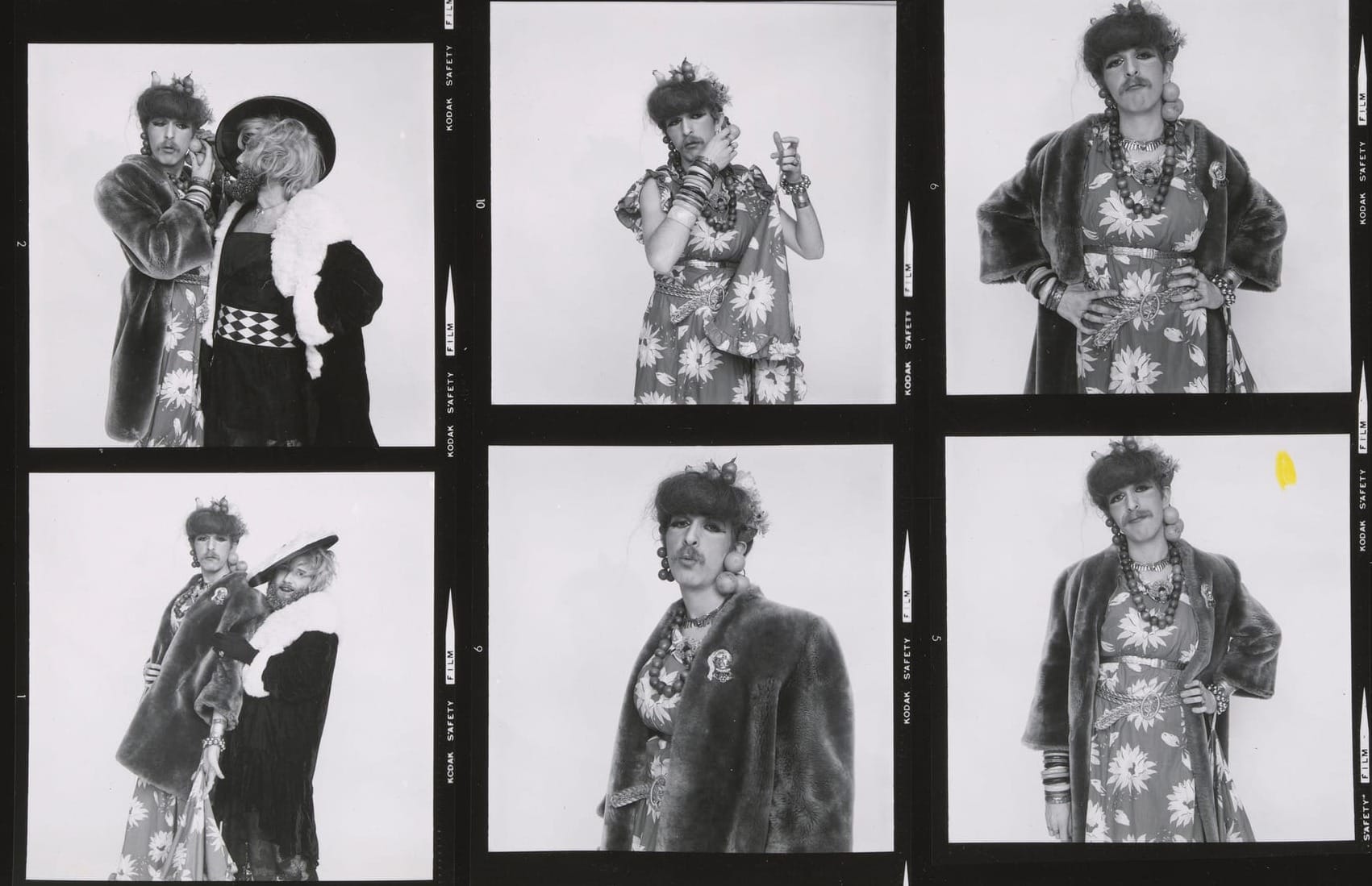
Should We See Peter Hujarâs Contact Sheets?
Though not made for public consumption, the darkroom work prints reveal his portraits as excerpts of a conversation, rather than memories snatched from the ether.
The Morgan Library & Museum might be milking its Peter Hujar collection, but Iâm not complaining. Hujar:Contact is the Morganâs second solo exhibition of the photographerâs work, coming on the heels of its 2013 acquisition of his archive and a sweeping 2018 retrospective, Peter Hujar: Speed of Life. That exhibition was always going to be a tough act to follow, given the scale of the show, the impact of its reception, and Hujarâs importance as a key portraitist of New York Cityâs before-they-were-famous queer art scene. Nevertheless, itâs an unusual choice to mount an exhibition entirely dedicated to a photographerâs contact sheets, which by nature are not made for public consumption.
For those of us more fluent in digital culture, contact sheets are darkroom work prints that allow photographers to see all the images on a roll of film and select which ones are worthy of printing, given the time and expense that full-size printing requires â essentially, itâs the equivalent of showing us screenshots of Hujarâs camera roll. As eager as I am for a nerdy deep dive into his process, which the exhibition undoubtedly is, Iâm left wrestling with the vague unease that it might also be an opportunistic mining of the photographerâs archive for all its worth. But Iâll check my paranoia at the door, because either way, the showâs outcome is good.
Entering the exhibition, the viewer is immersed on all sides in mural-sized photographic blowups of Hujarâs contact sheets and notebooks â a wise move, offsetting the small scale of the contact sheets (all 8.5 x 11 inches, or ~21.6 x 28 cm) and inviting one in for a closer look. (The trough full of magnifying glasses to borrow is also a nice touch). The introductory text is clearly prepared to reassure the cynic, stating at the outset that Hujar himself saved these materials for future scholars to study and âlearn how I got to the final print.â The Morgan is, of course, a library and a museum, which strengthens the argument for its archive-forward approach.
Visually, itâs more of a mixed bag, as contact sheets so often are. They are most interesting as objects themselves when the photographs on the film strips come together to form a broader image or pattern â as in his nudes âAndrew, English boyâ (c. 1972) and âBruce de Sainte Croixâ (1976) â or when the sheet appears to have inspired a repetition in the final print, like in âRay Johnson Twiceâ (c. 1966). Hujar, fortunately, did most of his shooting on medium-format 120 film, meaning that the negatives are larger (2.4 x 2.4 inches or 6 x 6 cm) and nicer to look at as a grid; the handful of contact sheets for his 35mm work (a smaller, rectangular format) are harder to appreciate.
The photographerâs annotations â dotting or circling his favorites, marking where to crop â occasionally provide a glimpse into his evolving thought process. In âSeven-part movement executed by Robyn Brentano, S. K. Dunn, and Charles Dennis of Robert Wilsonâs Byrd Hoffman School of Byrdsâ (1973), for example, Hujar numbers the images in a sequence that differs from the order in which he took the photographs, omitting some and reordering others to construct a smoother visual narrative. These notes-to-self helped him choose which images to make full-size (and thus more expensive) prints of later, and many such photographs hang nearby, like Hujarâs eternally moving 1973 portrait of Candy Darling on her deathbed alongside its contact sheet.
One walks away with the impression that, for Peter Hujar, photography was never a matter of the âdecisive moment.â The contact sheets reveal that his portraits were the product of ongoing interactions â excerpts of a conversation, rather than memories snatched from the ether. Sometimes, they betray the inherent awkwardness of trying to coax someone, even a friend, into revealing themselves for the camera. Itâs often harder to let down oneâs guard than oneâs clothes, and Hujar managed to capture his subjects doing both.
Left: Peter Hujar, âAndrew, English boyâ (c. 1972), Job 550, 16 sheets, contact sheet; right: âJay and Fernandoâ (1967), Job 322, 14 sheets, contact sheet
Left: Magnifying glasses for viewers to use to examine Hujar's contact sheets; installation view of Hujar:Contact
Hujar:Contact continues at the Morgan Library & Museum (225 Madison Avenue, Midtown, Manhattan) through October 25. The exhibition was curated by Joel Smith.