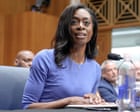
CDC nominee Erica Schwartz pressed on whether she will resist RFK Jrâs vaccine agenda
During confirmation hearing Wednesday, Trumpâs pick tells Senate health committee she will ânever betray the scienceâ
Erica Schwartz, the Trump administrationâs latest nominee to lead the Centers for Disease Control and Prevention (CDC), faced sharp questioning from senators who pressed her to say whether she would stand up to her boss, the health secretary Robert F Kennedy Jr.
During her confirmation hearing on Wednesday, Schwartz, a deputy surgeon general in the first Trump administration, told the Senate health committee she âwill never betray the scienceâ and pledged to use âradical transparencyâ to rebuild public trust. But she repeatedly deflected questions about how she would handle pressure from Kennedy, a leader in the anti-vaccine movement who has overseen months of turmoil at the agency and made controversial changes to US vaccine policies.
âWe need a CDC director that will â actually stand up to crazy, stupid things being said that undermine faith in immunization,â said the committeeâs chair, the senator Bill Cassidy, a Louisiana Republican and a physician.
Schwartz told him that Kennedy âwill absolutely allow me to be CDC directorâ.
The committee appeared likely to approve Schwartz, 54, who was nominated by Trump in April, calling her âincredibly talentedâ in a post on Truth Social. Kennedy later approved the choice, but refused to commit to supporting whatever vaccine guidance she might issue.
During the hearing, several senators focused their questions on Kennedyâs vaccine skepticism.
Democratic senator Maggie Hassan asked whether she would, were Kennedy to order her, suspend promotion of a flu vaccination campaign during a deadly flu season.
âSenator, I donât speak in hypotheticals,â Schwartz responded.
âIt isnât hypothetical. It happened,â said Hassan, referring to internal CDC emails, released by the senator Bernie Sanders in June, that documented such a directive from Kennedy to CDC staff last year.
Schwartz said she agreed that the CDC should prioritize responding to infectious diseases. âI think over time, the CDC has had some mission creep, and itâs trying to be all things to all people,â she said.
She said she had not seen a current CDC webpage that suggests a link between childhood vaccines and autism. Still, she declined to commit to taking the page down, though she agreed existing medical evidence had not found a link.
The change on the CDCâs website, made last year, received backlash from scientists and advocates, with CDC staff saying the updated page did not go through the normal, scientific clearance process.
Schwartz said she was also unaware that CDC programs that worked to prevent smoking and promote vaccinations had been curtailed. Meanwhile, she agreed to, if confirmed, look into whether AI datacenters cause health problems and into the possibility of establishing a World Trade Center Health Program clinical center in Florida.
Schwartz, a rear admiral in the US coast guard, previously served as deputy surgeon general during Trumpâs first administration. Over 20 years, she also has held positions in the US navy and the Public Health Service Commissioned Corps. While in the military, she oversaw the organizationâs system of 41 clinics and 150 sick bays â as well as policies promoting vaccinations of service members.
The physician has a bachelorâs degree in biomedical engineering and a medical degree from Brown University. Schwartz also holds a masterâs degree in public health from the Uniformed Services University of the Health Sciences, as well as a law degree from the University of Maryland.
Schwartz would, if confirmed, take the reins of the CDC after a tumultuous period of leadership turnover, marking the Trump administrationâs third pick to lead the agency. The first nominee, former Florida congressman David Weldon, was withdrawn by the White House in March 2025 just before his confirmation hearing.
The administration then nominated acting director Susan Monarez, who was confirmed but fired less than a month later for not aligning with the administrationâs agenda.
Monarezâs firing triggered the resignation of several senior CDC leaders, who stepped down in protest of Kennedyâs approach to vaccines and his management style.