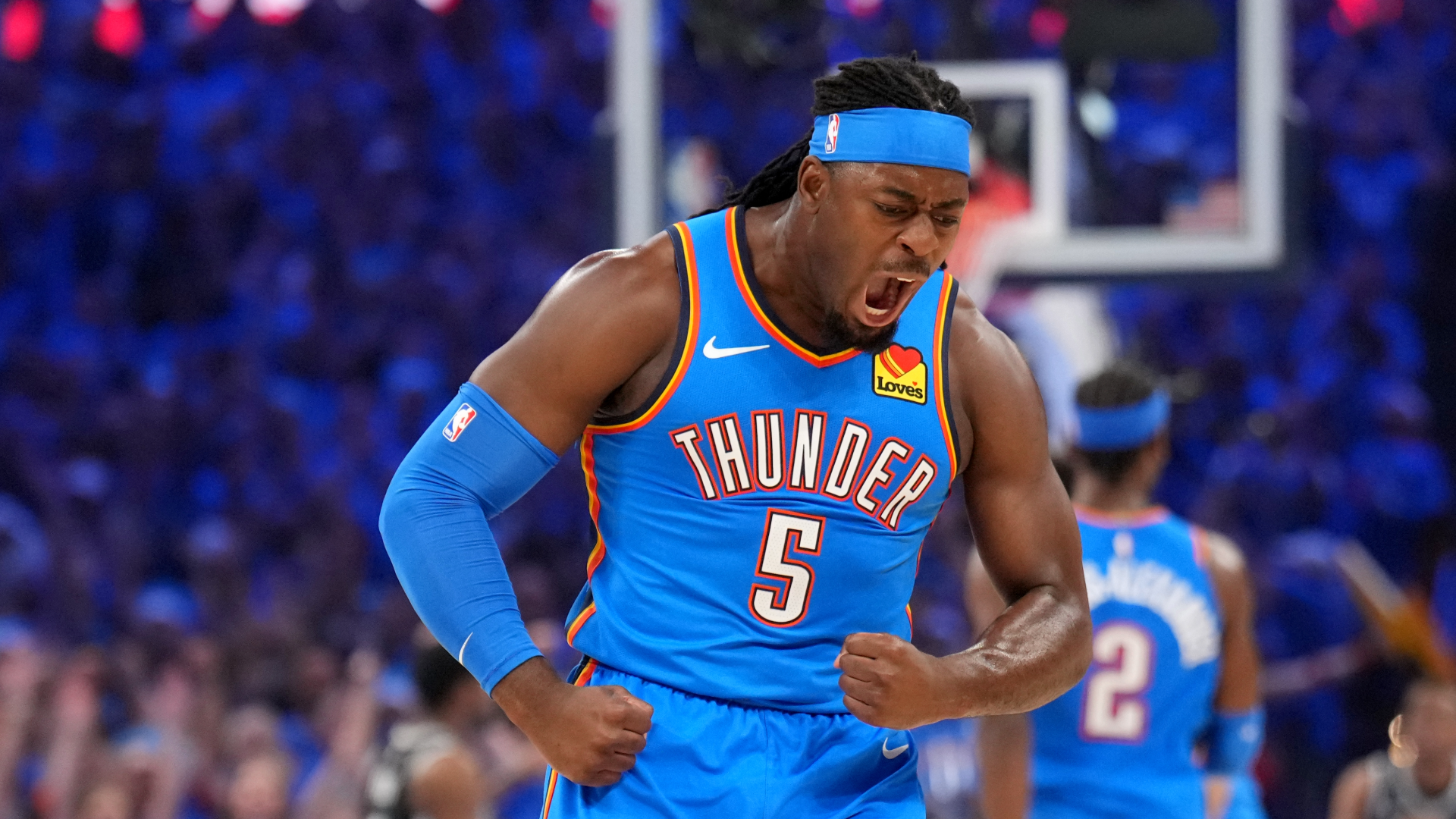
Lu Dort trade grades: Thunder clean up their books; Mavericks take buy-low swing on former No. 1 pick
The NBA has been quiet as it awaits a free agency decision from LeBron James, but for the first time since early July, we have a significant transaction. The Oklahoma City Thunder, Atlanta Hawks and Dallas Mavericks made a three-team trade Sunday, according to ESPN, headlined by Lu Dort and former No. 1 draft pick Zaccharie Risacher. The full details follow:
Thunder receive: 2027 second-round pick (from Bulls via Mavericks), 2031 second-round pick (more favorable of Hawks and Rockets), 2032 second-round pick (more favorable of Hawks and Lakers)
So, how did everyone do in Sunday's trade? Let's grade it to find out.
On some level, this was one of the most predictable trades of the offseason. The Thunder came out of the Western Conference Finals roughly $40 million above the second apron, and with years of high tax bills and second apron penalties looming, it made sense for them to do what it took to duck that line. The easiest path to doing so is what they actually wound up doing: trade the players who have been replaced in their rotation by, at least for now, cheaper alternatives.
The Thunder traded for Jared McCain at the deadline and, with two cheap years left on his contract, the more expensive Isaiah Joe was suddenly expendable. Aaron Wiggins simply got crowded out of the Oklahoma City rotation, so he was expendable as well. Dort remained a starter for Oklahoma City through the end of its season, but his workload was slowly reduced throughout the playoffs because of his inconsistent offense. His 20% 3-point shooting against the San Antonio Spurs is one of the big reasons the Thunder didn't hoist a trophy in June.
Meanwhile, the ascent of Cason Wallace forced Oklahoma City's hand. He is simply too good not to start full-time next year, and Ajay Mitchell is going to need a bigger role off the bench as well, creating a minutes crunch that needed to be addressed. The Thunder have another second-apron dance awaiting them next summer as Wallace is due a rookie extension and Shai Gilgeous-Alexander's supermax kicks in, but they're taking their financial issues one step at a time. For now, they've cleared the way to improve their starting lineup and gotten under the second apron in a single move.
Where Dort will be missed is in his ability to guard bigger, stronger players. Wallace is simply too small for such duties, and though Alex Caruso can defend anyone, the Thunder are very careful about his workload. If Jalen Williams is healthy next year, the Thunder can handle Dort's absence. If his injuries become more of a problem, Oklahoma City suddenly has a notable defensive vulnerability.
Trading a defender as accomplished as Dort for second-round picks hardly represents great value, but it was a move the Thunder needed to make to settle both their finances and their rotation. They also pick up a $17.7 million trade exception in the deal. Considering how expensive their roster is, they are unlikely to be able to utilize it, but it never hurts to have it in your back pocket.
The best trade partners in the NBA are poorly run teams. The Thunder are, quite obviously, the opposite. But the second-best trade partners in the NBA are the desperate ones, and while the Thunder weren't quite there this summer, the whole league knew they needed to save money, which created some interesting opportunities to buy low on players they no longer needed. The Hawks already did that with Wiggins, and now, through Dort, they've acquired two solid wings without giving up a first-round pick. In a league starved for these kinds of players, that's great business. Atlanta snuck into the top 10 defensively last year. They could be even better next season.
The Hawks are essentially Oklahoma City's financial opposite. The highest-paid Hawk, Jalen Johnson, would be Oklahoma City's fourth-highest-paid player, and the Hawks have a path to $40 million or so in cap space next summer if they want it. Perhaps a new deal for Dort cuts into that flexibility, but Atlanta has managed its contracts so well that it can afford to splurge when a team like the Thunder needs to save money.
The Hawks are used to playing with a different flavor of offensively limited wing in Dyson Daniels. Dort has at least been a solid shooter in the past, but he doesn't bring the ball-handling, passing or screening that Daniels does. If Dort's shot doesn't bounce back, the two may need to be staggered to be offensively viable. That's a solvable problem. You can never have too many wings, nor can you have too many mid-sized salaries for trade purposes. Between Dort, Jock Landale and CJ McCollum, Atlanta now has more than $50 million in expiring salary to trade with during the season.
It obviously stings to give up on a No. 1 overall pick after just two seasons. Risacher fell out of last year's rotation, but was much better as a rookie and is far from a lost cause. But Atlanta's roster situation has changed drastically since he was drafted. Remember, the Hawks still had Trae Young and Dejounte Murray on draft night in 2024. The only three players on the current roster to predate Risacher in Atlanta are Johnson, Onyeka Okongwu and Mo Gueye. Circumstances changed, and given how deep the Hawks now are, it seemed unlikely that Risacher had a path back into major minutes that didn't involve injuries to other players. He was a sunk cost to them, so they turned him into another high-level defender.
To Atlanta, Risacher was a sunk cost with few paths to major playing time. To Dallas, he's a pretty interesting buy-low candidate. Masai Ujiri loves his big forwards. In Toronto, he built a champion not only by trading for Kawhi Leonard, but by drafting Pascal Siakam and OG Anunoby. His first offseason in Dallas has included spending a No. 9 overall pick on Morez Johnson, trading for Santi Aldama, and, now, acquiring Risacher.
The goal here is to add as much size and defensive versatility next to Cooper Flagg as possible. Whether that's the optimal play around him long-term remains to be seen. He might be best-suited as a power forward, whereas this roster will almost certainly make him a small forward. But Flagg is 19. There's plenty of time to figure that out later. For now, the Mavericks are a team without control over its first-round picks between 2027 and 2030. Their paths to adding the sort of wings Ujiri tends to covet were limited, so taking a second-draft swing on a former No. 1 overall pick made all the sense in the world.
The history of No. 1 overall picks relocating after early career disappointments is certainly mixed. Anthony Bennett washed out of the league completely. Markelle Fultz hung around as a backup, and that's the path Deandre Ayton is headed down. Andrew Wiggins is probably the recent gold standard here, but he accomplished more with the Minnesota Timberwolves than Risacher did in Atlanta. Still, there's a clear path here.
Risacher is talented and relatively versatile. He has the tools to defend well, he's been decent enough from 3 and came into the NBA with good passing instincts that largely haven't materialized yet. There is the outline of a flawed yet potentially valuable player here. A Hawks team trying to win now didn't have the luxury of developmental minutes to spend on him. The benefit of building around a teenager as the Mavericks currently are is that they can afford to devote more developmental resources to him.
The Mavericks have now exhausted most of their financial flexibility for this summer. They're around $2 million below the luxury tax line, and Risacher will take up most of the trade exception left behind by Anthony Davis. But with Daniel Gafford and P.J. Washington becoming fixtures in the rumor mill this offseason, the Mavericks may have more moves left to make. For now, this is exactly the sort of flier a team in their position should be making. The risk is minimal. The potential reward is considerable.