Ken Turner, the 100-year-old artist who flattened a Tesla with a tank: âIâm not a revolutionary, Iâm a simple rebelâ
The painter, sculptor and performance artist has devoted his life to making art available to the masses. Now with a new exhibition, the centenarian discusses inequality, inspiration, and why he wonât be stopping any time soon
âLife is short, art long,â says Ken Turner, reading from a book of aphorisms by ancient Greek physician Hippocrates. And heâs half right, really, because at 100 years old â and very possibly the worldâs oldest performance artist â art might have been long, but life hasnât been all that short for him, either. And he has filled those years to the brim with radicalism, experimentalism and a singular dedication to pushing ideas as far as he can make them go.
In the 1960s, Turner moved from painting towards a socially conscious form of public art, creating giant inflatable sculptures that visitors could inhabit and interact with decades before immersive art became a thing. He was taught by Fernand Léger, he was mates with John Berger, he made frames for Frank Auerbach and Leon Kossoff. Last year, he drove a tank over a Tesla in a performance meant as a damning indictment of corporate greed and rising fascism. His has been a life of rebellion and revolution, of obstinately following his own artistic path no matter what obstacles he encounters, no matter how much easier it would have been to walk down a more well-trodden one.
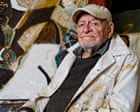
Heâs written two books: Crashing Culture and the brilliantly named A Life Being Ken Turner. Those two titles sum him up perfectly; he smashes art conventions to bits, all while being uniquely, resolutely and utterly himself. And heâs still at it: still performing, still painting, still making. Ahead of an exhibition of new work at Wharfside Arts Hub in Penzance, he sits in his kitchen talking about his life and work, dressed in a blue work shirt and cap. A Michael Eavis-esque moustache-less beard makes him look every inch the Cornwall creative that he is. Weâre joined by his son, the film-maker Huw Wahl, whose tender, grainy filmic portrait of his father plays on a loop in the show. âI think his painting is getting better and better, in a way, because heâs becoming more and more playful,â says Wahl. âBut Kenâs always been childish, in the best sense.â
âI was always interested in imaginative ideas, and the idea of play as an education in itself,â Turner says. âThe more you go through education into university, the more you forget to play, and playing is incredibly important.â
Turner has a lot to say, a lot of stories to tell, as youâd expect after 80 years of art-making. Dates and names may escape him now, but the anecdotes tumble out in an endless stream. He struggles to talk about the emotions and reasoning behind most of the work, but perhaps even at 100 years old heâs still processing it all. His art isnât a fait accompli. He doesnât seem comfortable looking backwards when thereâs so much still to look forward to.
Turner was drafted into the mines at the outbreak of the second world war, and eventually into the Royal Engineers. He emerged desperate to make art, but deeply suspicious of the art establishment and turned down a place at Londonâs Slade School of Fine Art because he didnât like the colour of the walls. âIf they canât get the colour of the walls right, how can they teach people?â he says. Later, he refused to do his final exam at Regent Street Polytechnic because they expected him to paint in an impressionist style, and turned down invites to show in the art galleries of the West End. âI didnât like the dealers, I thought they smelled foul, they looked crooked, and they were monsters in their own right.â At every stage, Turner has pushed back against expectations: âIâm not a revolutionary, Iâm a simple rebel, really.â
Instead, Turner worked as a framer before taking a position as a teacher at Barnet College and eventually Central Saint Martins. In the late 1960s, an encounter with a public project by radical theatre director Joan Littlewood inspired him to form Action Space, an art collective hellbent on taking art out of the galleries and putting it where the public could actually reach it. They described themselves as âan association of artists working in the community, through education and play, developing art forms relevant to a wider publicâ. They created vast inflatable sculptures you could walk through and perform in, they used light, sound, movement and drama, they put on events for children. This was socially conscious, community-engaged art well ahead of its time.
âWell, thatâs the social conscience I have,â Turner says when asked about making art for a wider public. âI almost cry about the inequality thatâs happening.â Action Space was about finding ways of connecting with people outside traditional, conservative art contexts. But rejecting the established gallery model to work in disadvantaged urban areas was also a continuation of his rebellious streak. âIt was something intuitive, it was in my bones to reject institutional thinking.â Action Space still exists today, in another guise, as a charity working with learning-disabled artists, including Turner prize-winner Nnena Kalu.
Get our weekly pop culture email, free in your inbox every Friday
It was also around this time that Turner discovered his love of performance art, a passion that peaked last year when he drove that 15-tonne tank over a Tesla in a project coordinated by guerrilla art provocateurs Led By Donkeys. âThereâs no difference between performance and painting for me,â he states. âI perform when Iâm painting, and Iâm painting when I perform.â And age is no barrier to that â heâll be performing at the opening of the new exhibition alongside his daughter.
Turner moved to Cornwall in the 1990s and rediscovered his love of playing around with brushes and oils, rekindling his passion for painting. Itâs still his main form of creative output, though that comes with its own pressures: âIâm still at that point where I need to sell paintings, but I donât want to go into the West End to sell them. Thatâs the art industry. I just intensely dislike the critics, and youâre not an art critic, are you?â
He looks disappointed at my response. That old suspicion of the art establishment rearing its head again. âWell, have a look at the paintings, and then decide who should buy them,â he says. So I do. Theyâre big, grandiose, semi-abstract things, often chaotic, sometimes violent, deeply emotional and overwrought. They deal with the destruction of Gaza, the impact of the climate emergency; they donât make for easy viewing. âI think museums should buy them,â Turner says. âThey instruct people, theyâre about the sadness of the planet, the development of cruelty and inequality thatâs happening.â
He cares deeply about the world, and he genuinely thinks art can help change things for the better. Is it that belief in artâs power that pushes him forward? âEven though Iâm 100, Iâll get to about 110 and Iâll still go on painting, because itâs signposted: âThis is the way, this is where you should go.â Itâs a voice inside.â
Itâs also a necessity. âIf I didnât [make art], Iâd die. It gives me life. If I donât paint, I get sick, I really get sick in my mind, and thatâs no good.â Even at 100, you get the feeling that as long as heâs got art in his life, Ken Turner could go on for ever.Ken Turner at 100: A Century of Crashing Culture is at Wharfside Arts Hub, Penzance, to 4 August.