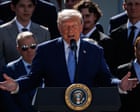
Trump accused of using forced labor as âconvenientâ justification for tariffs
US president faced criticism from Democrats after tariffs of between 10% and 12.5% imposed on more than 80 countries
Donald Trump has been accused of using forced labor as âa pretextâ to impose a fresh wave of tariffs on dozens of countries, as critics warned of higher prices for Americans.
The US president faced swift criticism from Democrats after his officials presented their latest effort to make his signature economic policy permanent following a string of high-profile legal setbacks. Some Republicans also expressed concern.
Hours before a temporary US duty of 10% on many countries was due to expire on Friday, the Trump administration announced new tariffs of between 10% and 12.5% on more than 80 countries, including the UK, Mexico, Canada, Australia, India, China and European Union members.
The new tariffs are being implemented under section 301 of the Trade Act of 1974, which allows the president to bypass Congress to instate tariffs designed to punish countries using forced labor to export goods to the US.
Trump ârecognizes that decades of moral suasion have not eradicated forced labor from global supply chainsâ, said Jamieson Greer, his US trade representative, on Thursday, adding it was âwell past timeâ that countries across the world eradicated the practice.
But as the US president continues to face questions over his controversial focus on tariffs, and the threat of higher prices, leading Democrats accused his administration of using forced labor to prop up their strategy.
âTodayâs forced labor justification is too convenient to be taken seriously,â said Richard Neal, the top Democrat on the US House ways and means committee. âForced labor is a real and pervasive problem in our supply chains and demands serious enforcement. It should never be cheapened into a pretext for a tariff policy built on dubious legal theories and personal grievances.ââ
Linda Sánchez, a California Democrat who also serves on the tax-writing committee, noted that Trump had gutted funding to combat forced labor at the Bureau of International Labor Affairs and rolled back worker protections domestically âwhile encouraging companies to profit off some of the worldâs worst forced labor abusers through his proposed US-China Board of Tradeâ.
âIf he was serious, he would not be applying the same tariff rate to China, one of the worst forced labor abusers in the world, as he does to countries like Australia,â wrote Sánchez. âThen again, unlike China, Australia, doesnât manufacture any Trump corporation products.â
Trumpâs trade strategy suffered a damaging blow in February when the US supreme court ruled 6-3 that many of his tariffs had been imposed illegally. His officials immediately announced another 10% tariff regime under another trade law that had never been used before, although these duties could only be imposed for up to 150 days â and expired after midnight EST on Friday.
This latest wave of tariffs is designed to replace the 10% regime. Democrats said the levies would accomplish little besides increasing costs for Americans amid inflation that has climbed to a three-year high â a message they have pushed again and again in the run-up to Novemberâs midterm elections, in which they seek to regain control of Congress.
âTrump has bled the inflation-battered American people dry with his tariffs. Now heâs coming back for more,â the Senate minority leader, Chuck Schumer, said. He urged Republicans âto finally grow a backbone â work with Democrats to reject this tax and bring down costs for the American peopleâ.
Brendan Boyle, the top Democrat on the House budget committee, cited an estimate by the Congressional Joint Economic Committee that US families have had to pay $3,500 more under Trumpâs policies, adding that new tariffs would only cost them more.
âFederal courts have repeatedly struck down President Trumpâs illegal and costly tariff taxes,â he said. âThese new tariffs are more of the same: a nationwide sales tax that will make life even harder for families already struggling under the costs of Trumpâs reckless war in Iran.â
A Harris Poll survey for the Guardian found earlier this year that 70% of Americans have reported paying more due to tariffs, and a majority of voters, including 60% of Republicans, say tariffs have had a negative effect on consumers.
All signs pointed to the latest tariffs being as divisive among Republicans as previous rounds, as they drew mixed responses from Trumpâs allies in Congress.
âTrue to its word, the Trump administration is fighting for American families, farmers and small businesses â as well as American values â when it comes to our trading relationships,â said the House ways and means committee chair, Jason Smith.
âHolding accountable those countries that are not doing nearly enough to rid their supply chains of goods produced with forced labor is appropriate to address unfair trading practices that put American workers at a competitive disadvantage.â
But John Cornyn, a Republican senator from Texas, raised concern about the effect of the tariffs on Americans. Cornyn is leaving the US Senate at this end of this term, after his Trump-endorsed rival, Ken Paxton, won the Republican nomination for his seat.
âThereâs no question that tariffs on imports raise prices on American products,â Cornyn told the Hill. âSo yeah, Iâm concerned about that.â