Plus-size models and £5 tickets: Sinéad OâDwyerâs runway show puts inclusivity first
V&A event celebrates all shapes and sizes as wider fashion industry stalls on body diversity
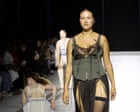
Visitors to Londonâs Victoria and Albert Museum on Friday afternoon to watch Sinéad OâDwyerâs Fashion in Motion show would have encountered something a little different. The cast of performers and models wore everything from underwear to skirt suits and sequins, and sometimes danced interpretively on the catwalk to a performance by the band Jeanie and The White Boys, but most notably came in all shapes and sizes.
OâDwyerâs work has pushed against fashionâs insistence on a thin body type since she appeared at London fashion week in 2021. If most brands make the samples for clothes shown on the catwalk based on a size 4-8, she uses a size 18. She has won awards for her work, as well as celebrity fans including Cardi B and Björk.
Fridayâs event â unlike a lot of fashion shows â was open to the public, who could buy a ticket for £5. OâDwyer says this more inclusive attitude suits her brand. âIn terms of the ethos [of the brand], itâs a lot more appropriate for everyone than the luxury fashion system, which actually doesnât really want everyone.â
For a few years, OâDwyer was part of a wider shift towards body diversity in fashion â with Paloma Elsesser the first plus-size model of the year at the Fashion Awards in 2023, for example â but progress has stalled. The Size Inclusivity Report, produced by Vogue Business every season since 2023, found that for autumn/winter 2026, 97.6% of models were âstraight-sizeâ, or a UK 4-8.
Fashionâs focus on the thin has been controversial since the early 20th century, with womenâs bodies long subject to trends â slight with a small bust as an ideal in the flapper 20s, slender and leggy in the youth-obsessed 60s, athletic and curvy in the aerobicised 80s. The current rollback to thinness can be seen as part of a wider trend away from diversity.
âIt coincided with Trump coming into power,â says Jeanie Annan-Lewin, a stylist. âThere are fewer people of any minority across the board and thatâs the same thing thatâs happening in fashion.â
Emma Matell, the casting director who worked on OâDwyerâs show and has also worked for Lueder and Tolu Coker, agrees. âItâs becoming more and more apparent that weâre back to wanting women to both metaphorically and physically take up less space,â she says.
The impact of GLP-1 weight-loss drugs is also part of the story. â[They] mean cultural figures are shrinking, the general population, in many respects, is shrinking,â says Lucy Maguire, the features director at Vogue Business. âItâs brought back a reverence for thinness that was always underlying in fashion.â
London remains the one fashion week that consistently features more body diversity â even if straight-size models still made up 92.7%, according to the Size Inclusivity Report. As well as OâDwyer, Mark Fast and Chopova Lowena will probably have a more diverse range at their shows in September.
âSinéad and a few other young designers are carrying a huge amount of effort that the rest of the industry seems unwilling to make,â says Matell. âBut I think that also comes down to the rebellious spirit of London. To me, being inclusive is the most punk thing you can do.â
The difficulty and cost of changing long-established manufacturing methods to make clothes in bigger sizes is central to the problem of body diversity in fashion. But OâDwyer believes even just seeing models of all sizes on the luxury stage has power. âLuxury is very deeply embedded in everything, even if you donât know anything about luxury,â she says. âThatâs what I definitely experienced as a young person. I didnât know why I wanted to be size 6, but I really wanted to be size 6.â
Friends Elenor Rowland and Orla McEvoy, both 14, watched Fridayâs show â their first interaction with fashion. Rowland said she was glad for the diverse casting âbecause a lot of the time thereâs not much representation for different body types ⦠It probably makes lots of people think: âOh, Iâm not that size. Maybe I should be.ââ
In the UK, size 16 is the average. Annan-Lewin sees fashionâs continued focus on the very thin to be a missed commercial opportunity. âI find it really strange that we just go âno, if youâre plus-size, you donât have any disposable income, you donât want to buy anything luxury. You just need to go and get fast fashion,ââ she says.
Maguire points to a survey conducted by Vogue Business that found â34% of mid-size and 68% of plus-size respondents felt alienated by the fashion industry due to their size, compared to 17% of straight-size respondents ⦠Brands need to represent different bodies in order to not alienate this consumer who has really huge spending power.â
To change things, all argue that financial support for brands trying to increase size diversity is needed. Annan-Lewin is clear itâs time for action. âI feel like I talk about things all the time, and itâs great, but water is wet,â she says. âWhat are we going to do about this? If we canât get that fatphobia out of here, then nothing is going to move forward in any way, shape or form.â