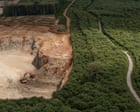
âItâs irreplaceableâ: Fury over Reform plans to expand quarry in ancient Kent woodland
Forty hectares of Oaken Wood could be razed after it was identified as potential site of expansion by Reform-run council
It was at the confluence of seven forest paths that Allison Sweetman came to a stop. Trees rose on all sides, save for a recently coppiced section to the north-east. The noon heat had silenced most birds, but the quiet was peaceful.
âThis is what they call Seven Wents,â she said. For centuries, the people of Kent had travelled this way, from East Malling to Barming, from Ditton to Teston, for church, commerce and friends. âItâs on maps going back 400 years.â
That may be about to end. Seven Wents is part of Oaken Wood, 40 hectares (100 acres) of which is all but condemned to be razed. Developers want the stone beneath. Kent county council, led by Reform, this month voted to include it in their mineral sites plan. That makes it a potential site of expansion for the quarry next door.
The council said its decision does not yet amount to planning permission â the plan needs government approval before that can happen. However, it does mean that they have identified the ground beneath the forest as an essential source of stone for building and restoration projects. Now, campaigners are on the march.
Continuously wooded since at least 1600, Oaken Wood is a plantation on ancient woodland site (paws), which means it is the site of an ancient forest that has been replanted. For centuries it has been worked as a sweet chestnut coppice, with whole sections felled in rotation, allowing the stumps to regrow.
The sun shone almost directly overhead, but the air was cool beneath the forest canopy. Sweetman, who knows the wood intimately and is a Green party councillor for the local area, led the way through green corridors flanked by almost impenetrable stands of plantation forest to another recently coppiced site.
With her were Rachel Rodwell, also a Green councillor; Julie Read, a campaigner; and Brontie Ansell, the managing director of Lawyers for Nature, who has been supporting their campaign to save the woods.
âIt takes about seven years before theyâre ready to be coppiced again,â Sweetman said. âAnd in the time they grow theyâre actually absorbing more carbon from the atmosphere than a fully grown tree ⦠Likewise their roots continue to grow, and that absorbs the surface water from rain.â
The wood is also a critical ecological site, supporting wildlife including dormice, nightjars and owls. Alongside the sweet chestnut coppices stand veteran trees, including old oaks. Bluebells and other wildflowers bloom here. The soil itself, bound by a mycorrhizal network that has built up over aeons, is a seed bank and a carbon sink, says Kent Wildlife Trust.
It is what is beneath the soil that developers want. Kentish ragstone has been quarried since at least the time of the Romans and was the building block of Roman London. Kent county council says it is crucial for the conservation of ancient buildings, including the Tower of London and Canterbury cathedral. Their opponents say it is wrong to place the conservation of the built environment over the conservation of nature. The council declined to comment.
There is little to distinguish Oaken Wood from any other ancient woodland site, said Ansell. âItâs protected in exactly the same way, legally, because itâs not just about the fact that thereâs newish growth of trees,â she said. âYouâve got all the soils, youâve got the fungi, youâve got all of the wildlife.â But, she added: âIt is still irreplaceable. You couldnât just create this somewhere else.â
But that is precisely the plan, should development go ahead. Gallagher Group, which runs the Hermitage quarry, said the soil beneath the wood would be âtranslocated and retainedâ â dug up and moved elsewhere. The ânon-nativeâ chestnut trees, which have been in the UK since the time of the Roman empire, would be removed and they would âput back more than double the tree planting in restored, native woodlandâ.
Campaigners are sceptical. âEssentially they lift a lot of the topsoil ⦠and then they chuck the topsoil down somewhere and go: âThere you go, itâs been replaced,ââ Ansell said. Rodwell added: âItâs just treated like garden topsoil. And they forget the interconnectivity. Itâs not [just] the soil, itâs a living system.â
The planet's most important stories. Get all the week's environment news - the good, the bad and the essential
Last year, more than 25,000 voiced their concerns in a consultation on the plan. The Woodland Trust and Kent Wildlife Trust are opposed. Maidstone borough council, on which Sweetman and Rodwell sit, passed a rights of nature motion in April.
On from Seven Wents, the group walked north, towards the site of the existing quarry, which swallowed up 80 acres of the wood just over a decade ago. With every step, the sounds of machinery grew louder.
Soon the air was thick with the smell of exhaust fumes and the ra-ta-ta-ta-tat of pneumatic hammers against stone. White powder, apparently rock dust, lay in a film across the forest foliage. A dead shrew lay on the floor. âYou can breathe it, you can smell it, you can feel it in your lungs,â Rodwell said.
In the course of just a few short minutesâ walk, the group had travelled from a sylvan idyll to what felt like a zone of war against nature.
âWeâre treating nature as a commodity or a resource and weâre forgetting weâre part of the same system. And itâs this sense of entitlement that we can just strip it away and plunder it,â added Rodwell.
âItâs replicated across the country, across the globe.â
The best public interest journalism relies on first-hand accounts from people in the know. If you have something to share on this subject, you can contact us confidentially using the following methods:
The Guardian app has a tool to send tips about stories. Messages are end to end encrypted and concealed within the routine activity that every Guardian mobile app performs. This prevents an observer from knowing that you are communicating with us at all, let alone what is being said.
If you donât already have the Guardian app, download it (iOS/Android) and go to the menu. Select âSecure Messagingâ.
Our guide at theguardian.com/tips lists several ways to contact us securely, and discusses the pros and cons of each.
This article was amended on 31 July 2026 to remove an image for editorial reasons.