Suspected mass bird flu deaths found in second state as Murray Watt warns âthis is the beginningâ
Environment minister says Australia has âlong and difficult journeyâ and says more mass mortality events likely
Get our breaking news email, free app or daily news podcast
Aerial surveillance has detected mass bird deaths in a second Australian state in another suspected escalation of the spread of deadly H5 bird flu.
The environment minister, Murray Watt, said on Monday Australia had begun âa long and difficult journeyâ as CSIRO analysis confirmed Australiaâs first mass mortality event at Baudin Rocks off South Australiaâs coast.
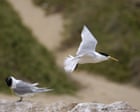
Hours later, Victorian authorities said aerial observations had identified a âclusterâ of dead and sick greater crested terns in the Glenelg River estuary near Nelson and across Lawrence Rocks, in the stateâs south-west, over the weekend.
If samples taken from the Victorian birds return positive results, it would be Australiaâs second confirmed mortality event from the deadly disease that has devastated wildlife populations globally.
âI want to level with people: this is the beginning of what is likely to be a long, difficult journey in terms of the impacts on wildlife,â Watt said on Monday.
Aerial surveillance over Baudin Rocks identified about 50 dead and 30 sicks birds, the South Australian government said on the weekend.
Samples taken from five greater crested terns and a silver gull were sent to the CSIROâs Centre for Disease Preparedness and confirmed positive on Monday.
âThe reality is, you canât stop native and wild birds flying around, and you canât stop wild animals moving around, and that will mean more mass mortality events like the one we have now seen,â Watt said.
âWhat we can do, and what we have been doing, is build up the resilience of the populations of our native birds and mammals.â
In Victoria, the stateâs chief biodiversity officer, James Todd, said aerial surveillance had made observations that were âconsistent with what was recently reported in South Australiaâ.
Speaking to media on Monday afternoon, the stateâs chief veterinary officer Dr Graeme Cooke said aerial and ground surveillance in the south-west, near Portland and Nelson, in the past few days showed âa clear increase in the number of dead terns along that part of the coastâ.
Get the most important news as it breaks
âLast week we talked about individual detections; the first cases of the H5 bird flu in Victoria. We are now seeing a change as the disease spreads out and has further impacts,â he said.
The region is home to an important breeding colony of Australasian gannets as well as seal colonies and the Glenelg estuary and Discovery Bay, an internationally significant wetland site.
South Australiaâs environment minister, Emily Bourke, said she was also concerned about a confirmed case of H5 bird flu in a petrel found in the Coorong, one of several new locations where the deadly disease has been detected in the state.
The migratory petrel was one of 18 new cases in SA confirmed by CSIRO on Monday, which included the samples from six birds at Baudin Rocks.
The new cases included a silver gull in Glenelg, two greater crested terns at Troubridge Island, a silver gull at Southend, a greater crested tern at Monarto and six greater crested terns on Pages Islands.
The Coorong is a large area that is home to internationally significant wetlands that support populations of waterbirds and migratory species.
âThat confirmed location is of concern because it is where waterbirds are also located,â Bourke said
âSo itâs going from seabirds, but also potentially now into where we know a lot of waterbirds are nesting and using this space as a safe haven.â