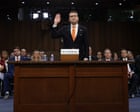
Todd Blancheâs attorney general nomination will advance to full US Senate vote
Blanche, formerly Trumpâs personal lawyer, confirmed in writing that $1.8bn slush fund for presidentâs allies was dead
The US Senate judiciary committee voted along party lines to advance Todd Blancheâs nomination for attorney general after he confirmed in writing that a planned $1.8bn slush fund for Donald Trumpâs allies was dead. Experts say, however, that Trump could easily reverse the deal.
His nomination will now proceed to the full Senate, where it will probably face intense skepticism from Democrats.
Ahead of the vote on Tuesday, every Democrat on the committee railed against Blancheâs nomination, saying he was unfit for the role and would do the presidentâs bidding. They emphasized his work defending the controversial fund, his mishandling of the files related to Jeffrey Epstein, the murder of Alex Pretti and Renee Good, and prosecutions of protesters and Trumpâs political rivals.
âWe are going to advance out of this committee probably the most discreditable person ever to seek the office of attorney general of the United States,â said Sheldon Whitehouse, a Democratic senator from Rhode Island.
Blanche, one of Trumpâs most trusted legal aides and formerly his personal defense lawyer, has faced questions over his suitability to lead the Department of Justice, which is supposed to operate independently of the White House.
He signed an order scrapping the so-called âanti-weaponizationâ fund â a roughly $1.8bn pool of money created in May as part of a settlement ending Trumpâs lawsuit against the Internal Revenue Service â in an attempt to defuse a Republican rebellion over his nomination.
The lawsuit came after the leak of the US presidentâs confidential tax records by a former IRS contractor, who has been serving a prison sentence since 2024.
Trump had cast the fund as compensation for people he claimed were unfairly targeted by politically driven investigations, and defended it as recently as this weekend. Critics said it risked becoming a taxpayer-funded payout to Trump loyalists, including some defendants from the January 6 Capitol riot.
The most consequential criticism stemmed from two Republican members of the judiciary committee, John Cornyn of Texas and Thom Tillis of North Carolina. Blancheâs nomination required their support.
But both outgoing senators have turned on Trump, recently telling party leaders they would not let Blancheâs confirmation move without firm guarantees that the fund would be shelved for good.
Speaking ahead of the vote on Tuesday, both Cornyn and Tillis said their concerns had been satisfied.
Tillis described the anti-weaponization fund as a âpayout pot for punksâ, but said he was satisfied it would not be moving forward.
âIâve never liked this 1776 fund. It made no sense to me, and I thought it was an insult to the police officers and the people that defended us on January the sixth. Itâs done. Itâs been rescinded, and I am satisfied,â he said.
Despite saying he would vote for Blanche, Tillis lamented the politicization of the justice department under Blancheâs leadership. He criticized the departmentâs ongoing prosecution of the former FBI director James Comey in eastern North Carolina over a picture Comey posted with seashells arranged saying â86 47â â shorthand for getting rid of Trump.
âSome bonehead in North Carolina thinks that thatâs a crime. Well, they better damn sure have information to back it up because if all it is is a picture, that person should lose his job, his or her job,â Tillis said.
Cornyn and Tillis faced public criticism from Trump over the weekend for pushing Blanche to put in writing that the anti-weaponization fund was dead and the scope of the tax immunity was limited. Cornyn defended the push on Tuesday.
âWhile this may sound like nitpicking to some, itâs critically important not only to me but to other members of the Senate,â Cornyn said. âGiven this agreement with Mr Blanche, I expect the department to live up to to this in future litigation.â
Echoing the concerns of many other Democrats, Cory Booker, a Democratic senator from New Jersey, said the agreement with Blanche offered little assurance the justice department could not reverse itself and go ahead with the fund anyway.
âIâve been here 14 years. I have not seen something as farcical as what Iâve witnessed over the last few weeks,â Booker said. âIâm going to say it very clear: this is all hat and no cattle.â
In his order, released on Sunday, Blanche stressed that the fund had never actually been operational: no board had been appointed, no money moved, and no claims filed or paid.
While there was concern that the settlement also provided broad immunity for Trump and members of his family from tax audits, the US Department of Justice separately clarified the IRS-related order was limited to the plaintiffs in the original settlement, and did not amount to blanket protection from future audits.
Both Cornyn and Tillis later confirmed they would vote to advance Blancheâs nomination.
Because the underlying settlement still references the fund, a future attorney general â or Trump himself, with Congressâs help â could try to revive it. Trump added to that uncertainty over the weekend, saying that if Blancheâs confirmation stalled, he would simply keep him on in an acting capacity and push lawmakers to create the fund through legislation instead.