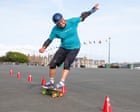
A new start after 60: I took up slalom skateboarding â and Iâm off to the world championships!
Darren Miles had skateboarded all his life. But in his 50s, he realised he was losing his skills and flexibility. So he took it in a new direction
Darren Miles never thought he would compete in any sport for Britain. But in October, he will represent Great Britain in slalom skateboarding â a form of downhill racing â at the World Skate Games in Paraguay. Last week, he completed his World Anti-Doping Agency awareness training. He had to tick a box confirming: âIâm an international athlete.â
âJustificationâ is the word that comes to mind, he says. âA feeling that I havenât wasted my life skateboarding, that diverging into something newâ â he took up slalom in his late 50s â âand working hard at it has yielded a result of which I am very proud.â
âItâs now a personal ambition,â he adds, âto do my best. See who I can be.â A new feeling for someone who has lived with âall my light under a hundred bushelsâ.
What he doesnât often hear, heâs pleased to say, is: âArenât you too old?â
Miles is 60 now, but he used to get asked that all the time when he was a teenager, skating to the shops or on the ramps where he lived in Colchester, Essex. His mum gave him a skateboard when he was 10; his aunt worked in the manufacturing factory. âWe were the first generation of British skateboarders. And we didnât know how long you could skateboard for. We just did it because we could do it,â he says.
He pulls the little orange board his mother gave him out from beside his desk; itâs one of seven boards he keeps at home in Plymouth, south-west England.
Miles has used a skateboard for almost his whole life â in his 20s, he skateboarded alongside his job repairing cameras, and in his 30s, while he went to university to study ocean science. He could ollie (a jumping technique) on to a handrail and slide down it, and he once skateboarded the legendary pipeline under the Mount Baldy reservoir in California. In his 40s, he continued to skateboard while working as a consultant specialising in flooding. He now manages flood risk for the local council.
But a few years ago, he began to sense his world diminishing. âThe amount of people I knew was shrinking.â And his flexibility was deteriorating.
During Covid, taking his skateboard to the local park, he realised: âI would slowly be unable to do these tricks, one by one.â He completed a âquite basicâ trick â a 180-degree turn â and a stranger voiced an appreciative âYeah!â
ââOh, no!ââ Miles thought. ââThis is a grim glimpse into the futureâ ⦠They were impressed that I was an old person doing an easy trick. That didnât sit comfortably with me.â
Having sat a while with âthe pain of my lost youthâ, he made a conscious decision to take up slalom. He has had to learn new ways to move his body, and how to build momentum while changing direction between the cones on the racecourse. âYou have to pump through. Itâs unexpectedly physical ⦠Youâre always judging, relearning what youâre capable of.â
Managing speed and sharp redirections â the course sounds like a lifetime in miniature. âItâs a surprising amount that happens in 15 seconds,â he says.
Slalom appealed because Miles believed âthere must be an element of learning at the beginningâ. An upward curve, âwhere you get betterâ. For anyone who enjoys skateboarding, itâs âa surprising way to extend your skateboarding lifeâ. He mentions Tony Alva, the American skateboarder who will turn 70 next year.
Slalom has also enlarged Milesâs circle of friends. âRacing has a habit of forging close friendships in a short time,â he says. Heâs raced in Cambridge, London, France, Germany, and trains at an annual slalom camp in Czechia.
Occasionally he still dreams of skateboarding the ramps, as he used to, âwhen you carve up and you float â weightless, thatâs a very seductive sensationâ. Slalom carries the risk of banging his head or breaking a collarbone; competitors move so fast, they donât know theyâre falling until they land.
But itâs the âupbeat and positiveâ attitude of slalom that appeals to him. âYou canât imagine not making it. You have to visualise yourself rolling out of the course.
âI find it amazing what humans can learn to do with enough time and commitment.â
Tell us: has your life taken a new direction after the age of 60?