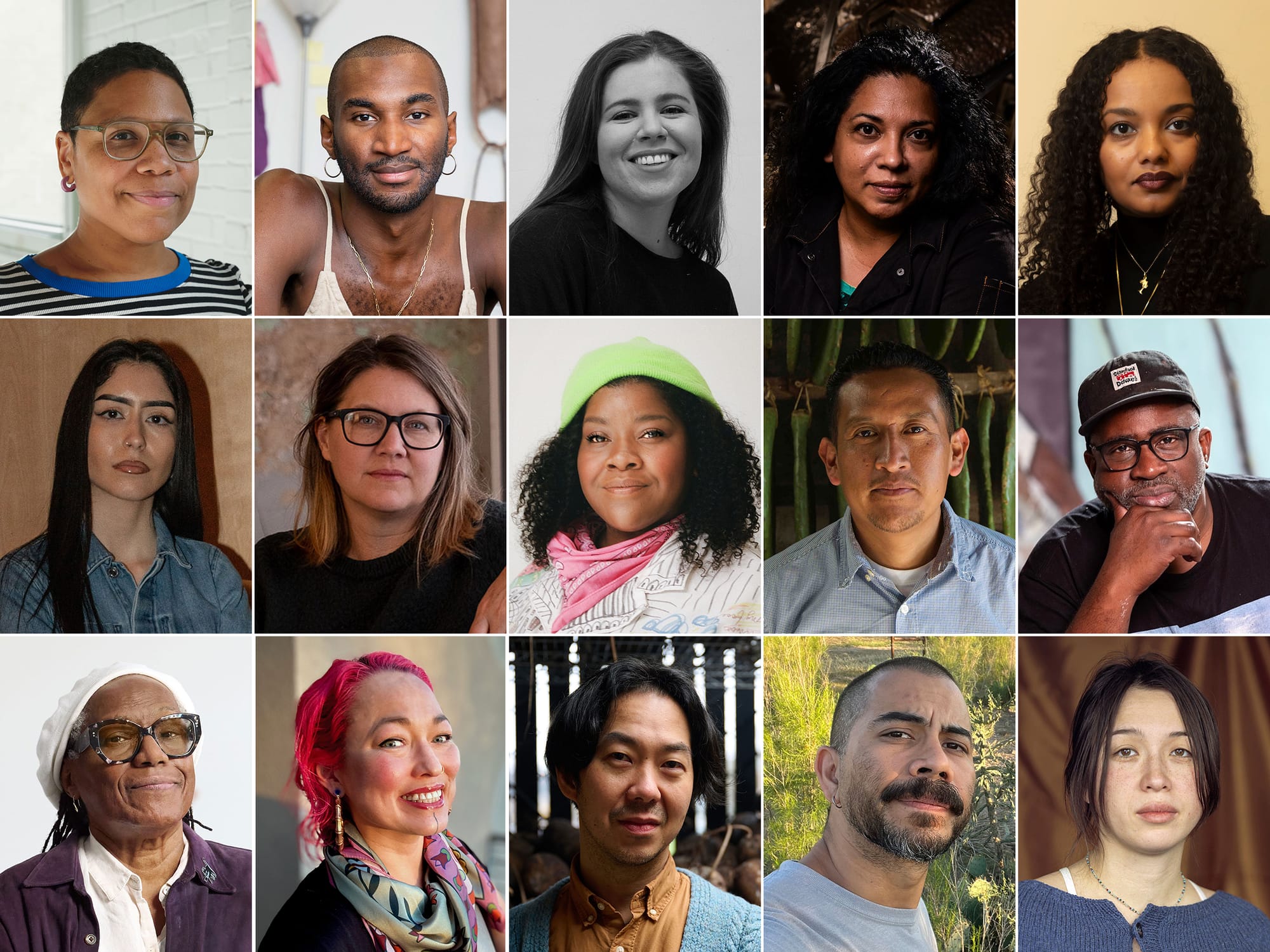
15 Artists Named 2026 Joan Mitchell Fellows
Each recipient will receive $60,000 in unrestricted funding distributed over five years, in the spirit of the namesake abstract painter’s commitment to “aid and assist” artists.
The Joan Mitchell Foundation announced today the recipients of its 2026 Fellowships, one of the most coveted prizes awarded to visual artists in the United States. The 15 fellows will each receive $60,000 in unrestricted funding distributed over five years, in the spirit of the late abstract artist's stated commitment to “aid and assist” painters and sculptors.
This year's fellows are Krista Clark (Atlanta, GA), Cameron Clayborn (Memphis, TN), Sarah Elizabeth Cornejo (Davidson, NC), Beatriz Cortez (Los Angeles and Davis, CA), Azza El Siddique (New Haven, CT), Sam Frésquez (Chicago, IL), Coulter Fussell (Water Valley, MS), vanessa german (Blue Ridge Mountains, NC), Porfirio Gutierrez (Ventura, CA), Roscoe Hall (Birmingham, AL), Janet Olivia Henry (Jamaica, NY), Erica Lord (Santa Fe, NM), Rob Rhee (Seattle, WA), Ruben Ulises Rodriguez Montoya (Sunland Park, NM), and Dianna Settles (Lexington, KY).
“Having an award that you know is coming year after year is so important because of what you can explore long-term,” said fellow Beatriz Cortez in a phone call with Hyperallergic.
Cortez was finalizing a commission for the Boston Public Art Triennial when her home burned down in the devastating Altadena Fire in 2025. Though grateful for an outpouring of support, she was “exhausted,” and found it difficult to dive back into the heart of her practice: large-scale sculpture.
The El Salvador-born, LA-based artist was recently appointed professor of Chicana/o/x Studies at the University of California, Davis, and also teaches in the school's art program. In her own studio, she gives contemporary form to ancestral knowledge through monumental artworks such as welded-steel monoliths modeled after Maya stelae exhibited at the Storm King Art Center and the Venice Biennale — a labor-intensive practice that benefits from the freedom to experiment with different mediums and processes.
Asked what the Joan Mitchell award means to her, Cortez responded with one word: “stability.”
“I know [the fellowship] will transform my practice because I will have the opportunity to make the works that I dream of, and also explore new ways of working,” Cortez said.
Other fellows this year echoed this desire to “take up space,” in the words of Krista Clark, who said the no-strings-attached funds will allow her to hire a studio assistant and work at a greater scale. Cameron Clayborn, another recipient, will invest in a nearby studio space, and Sam Frésquez will purchase a small truck to acquire and transport bigger materials. Dianna Settles sees a transition from “working within constraint toward building a more materially rigorous, conceptually integrated, and ambitious body of work over time.”
Janet Olivia Henry, who is the oldest recipient this year at age 79 — the youngest is 29 — articulated a common yet less frequently discussed challenge for artists whose trajectories do not reflect traditional, linear paradigms: “The paradox of late-career recognition is that my work is being treated as historic material while I’m still here,” she said. The artist and educator plans to use the fellowship funds to tackle legacy planning, bookkeeping, taxes, documentation, and storage.
Launched in 2021, the Joan Mitchell Fellowship transformed the nonprofit's previous grant offerings into a program that could sustain artistic practices over time, rather than provide one-time cash infusions. Factoring in the community-building and skill development opportunities also offered to fellows, the foundation's total commitment is about $1.3 million per cohort.
“Artists have told us, again and again, that careers stall not for lack of talent, but because they need more consistent support, tools for self-advocacy, and access to art-world networks and engaged peers,” Solana Chehtman, director of artist programs at the Joan Mitchell Foundation, told Hyperallergic.
The selection process involves an initial pool of artists recommended by 125 nominators, who are then asked to submit online applications. This year, 41% of nominators identified as working artists, the foundation said.
Christa Blatchford, the Joan Mitchell Foundation's executive director, emphasized the connection between the fellowship's present priorities and the values of its namesake, particularly the “generosity she showed to other artists.”
“For more than 30 years, we have built on that spirit through unrestricted grants, trusting that each artist knows best what they need to support their career and achieve their goals,” Blatchford said.