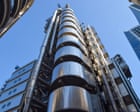
âEven its loos are on the outsideâ: hi-tech, inside-out marvel the Lloydâs building is partying with the public
It has been likened to a monster, an oil rig â and the Parthenon. Now, for its 40th birthday, the astonishing London landmark has joined the Open House festival, to grant admirers a rare look around the inside
In his 2012 book A New Kind of Bleak, the critic Owen Hatherley called it âmonstrous, compellingâ and utterly messed-up. Back in the 1980s, a then Prince Charles suggested it had been inspired by a North Sea oil rig. But none of this stopped it from becoming, in 2011, the youngest ever building to be given Grade I-listed status in the UK.
And now, as part of its 40th anniversary celebrations, the Lloydâs building will open to the public for the first time since 2014 for one day only during Londonâs Open House festival. The iconic building in the heart of the financial district was designed by architect Richard Rogers to house the global insurance marketplace. Its futuristic facade has been a celebrated part of the City of London skyline since it opened in 1986, but the interior is rarely seen by the public. Visitor galleries with a view of the trading floor have long been shut for security reasons.
Open House festival is organised by the charity Open City, which aims to make architecture more accessible by inviting government offices, private properties and heritage buildings to let the public in. Free tickets for the Lloydâs building are released tomorrow for the one day the building is open, on 19 September. The tour will include the underwriting room and the Adam Room as well as examining how the building was designed. âThere was whooping in the office when the Lloydâs building came in,â says festival director Celia Mead, âbecause we know our visitors really, really want to get inside this landmark institution.â
Lloydâs is a key example of British hi-tech architecture. This late modernist style evolved in the 1970s and celebrates industrial engineering and prefabricated materials. Lloydâs is famous for its exposed concrete frame and the six external steel towers that house its staircases, lifts, pipes and ducts. The buildingâs 12 glass lifts were the first of their kind in the UK, and each tower is permanently topped with steel cranes - partly for maintenance but also to make the building look like a gothic cathedral.
âItâs a masterpiece of radical, inside-out architecture,â says Mead, ârepresenting Londonâs confidence and swagger.â From the street, she says, âit catches the attention and you wonder, âWhat could it be like inside?ââ Mead has experienced the building first-hand: âMy mum was an economics teacher and I joined one of her school trips to Lloydâs 38 years ago. I remember then thinking it was huge.â
With all the infrastructure removed from the inside, the Lloydâs building has capacity for a double-height space for the trading floor and a galleried atrium that reaches to the steel and glass barrel-vaulted roof, 14 floors above. Historian Reyner Banham compared the atrium to the Parthenon when he presented Rogers with the Royal Institute of British Architectsâ gold medal in 1985.
The building also includes historical artefacts from Lloydâs of Londonâs 338-year history. The Adam Room, originally designed in 1763 for Bowood House in Wiltshire by neoclassical architect Robert Adam, was sliced into 1,500 pieces in 1958 and moved to Lloydâs HQ. The old library from Lloydsâ former home in the Cooper building on Leadenhall Street â designed by Sir Edwin Cooper in 1928 â was similarly salvaged. There is also a 1958 war memorial stained glass by artist Hugh Easton while, on the main trading floor, the Lutine Bell sits, hung within a mahogany, pillared temple. The bell, rescued from the wreck of HMS Lutine, has been used since 1858 to alert insurance underwriters to a maritime disaster. Itâs still used to acknowledge ceremonial occasions such as Remembrance Sunday.
The Lloydâs buildingâs place in British culture is nuanced. It appeared in 1986, the same year the City was deregulated, and came to symbolise that gear change to a voracious capitalist financial market shaped by international powers. The designâs references to industrialism and religion married to futurism invite ruminations about ideas of power in British history.
Architecturally, though, its reputation has endured. Not everyone is as damning as King Charles. Historian Geraint Franklin, of Historic England, who last year featured the building on the cover of his book High-Tech Britain, says it was designed to adapt and evolve. âLloydâs is flexible. Its services, lifts and even loos are mounted on the outside, freeing up the workplace inside. In recent years, the glazing has been renovated, carefully recutting the original âsparkle glassâ.â This refers to textured glass panes that refract light so the building glitters in the sun.
âThe main trading areas have been recently refurbished,â adds Franklin. âOn paper, the plan is rational and diagrammatic, but itâs a dynamic, romantic exterior. Lloydâs was never intended to be taken in at a single glance but to be encountered in snatched views from the streets. Itâs obsessively detailed â with stainless steel, glass and white concrete making up a sharp City palette, highlighted by careful lighting.â
Mead is just pleased that more people will get to experience this. âIn our programme of over 730 buildings, Lloydâs is perhaps the greatest statement building. Itâs heavyweight, look-at-me and counterintuitive. Weâre all about the social impact that access brings â it gives people a sense of belonging to the city. Canât wait to hear what they say about Lloydâs.â
Tickets to Lloydâs are free but must be booked in advance at openhouse.org.uk. Booking opens at noon on 19 August. London Open House festival runs 12-20 September.