Venice Biennale closing celebration to feature aria from artist Tammy Nguyen’s first opera
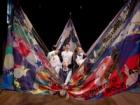
Rehearsal for Tammy Nguyen's Timaeus and The Teacher: Foreword, an aria that will be part of the closing events for the 2026 Venice Biennale Photo by Elisabeth Bernstein. Courtesy the artist and Lehmann Maupin, New York, Seoul, and London.
Last summer, as Tammy Nguyen was opening her solo show at Lehmann Maupin’s New York gallery, she met with the curators of the 61st Venice Biennale to discuss her participation in Koyo Kouoh’s exhibition In Minor Keys (until 22 November). Nguyen’s artistic concerns at the time built upon years of deep research into topics—history, philosophy, ecology, mathematics and geopolitics, to name a few—that she examined through paintings, prints and artist books. Yet when Nguyen spoke with the curatorial team that took over after Kouoh’s death, their interest was diverted.
“I presented my artist books, but Rory [Tsapayi] saw what I was working on and asked, ‘What’s with all of these flags?,’” Nguyen tells The Art Newspaper. “I said, ‘Funny you should ask, I’ve been writing an opera.’”
Today, the fruits of this conversation have been revealed with the Venice Biennale’s announcement that an aria from Nguyen’s opera will be presented during the closing programme on 13 and 14 November. Titled Timaeus and The Teacher: Foreword, the aria and larger opera explore nationhood and journeys for freedom. Working with the composer Neely Bruce and the choreographer Jamal Jackson, the piece was commissioned and produced by Wesleyan University in Connecticut, where Nguyen is an associate professor.
Portrait of Tammy Nguyen Photo by Axel Dupeux. Courtesy the artist and Lehmann Maupin, New York, Seoul, and London.
“Koyo [Kouoh] wanted the biennale to show the full breadth of each artist’s work,” Nguyen says. “The Venice Biennale has such national pageantry, it makes sense that an opera that questions nationhood is fitting for the show.” The artist also has a series of paintings on view in the Biennale’s main show.
Flags had been an interest of Nguyen’s for some time and were at the centre of Timaeus and the Nations, her Sarasota Art Museum exhibition in 2024-25. Specifically, she was exploring the “flags of convenience”, the practice of registering a ship under the flag of another nation and thereby becoming subject to that nation’s laws. Roughly 46 nations, many of them former colonies, allow foreign nationals and vessels to register under their flag. Shipowners register their vessels in others nation for various reasons, very often to take advantage of labour regulations or favourable taxes.
Works by Tammy Nguyen on view in In Minor Keys, the 61st International Art Exhibition of La Biennale di Venezia, until 22 November Photography by Studio Kukla. Courtesy the artist and Lehmann Maupin, New York, Seoul, and London.
For the Sarasota exhibition, Nguyen took lyrics from different national anthems of the countries that participate in flags of convenience and wrote haikus by extracting phrases from the music and mixing the anthems arbitrarily. Using these hybridised anthems, along with recombined imagery from flags, she created new patterns and forms in paintings to distort and confuse their meaning.
“It was from these musical phrases that I wrote a libretto,” Nguyen says, adding that she used a Fibonacci module to obscure the phrases and think of the story of “the teacher” through Plato’s Timaeus (a dialogue on the creation of the universe). “The teacher sings partly in broken English, but through the logic of the universe, you start to understand what he’s saying,” Nguyen says.
In her libretto, The Teacher, played by Brian Vu, is a young Vietnamese man who teaches English to Chinese gold traders before attempting to flee Saigon by boat in 1977. Loosely based on Nguyen’s father, he joins other travellers seeking freedom, only to encounter the contradictions of global maritime trade: goods move freely across borders, while people are restricted by nationality. His journey questions the meaning of belonging in a world shaped by political borders and forces beyond human control.
“When my dad was at sea as a refugee, he saw a lot of boats that were so overcrowded their engines would break down,” Nguyen says. “This happened to their boat in the South China Sea, which is a very busy conduit for trade and marine traffic, and a Sunoco oil tanker saved their boat. My dad spoke and taught English, so he ended up doing a lot of the communicating, and he found out the captain of the Sunoco ship, which is an American company, was a German Holocaust survivor. The captain helped them because he understood their plight.”
Nguyen designed the set around a circular tapestry inspired by the cosmological diagram in Plato’s Timaeus. The dancers manoeuvre the tapestry, folding it, wrapping it around themselves, stretching and compressing it, revealing imagery that shifts between sea, ship and mountain range, while catching and reflecting light. The shifting object and the dancers’ movements collapse distinctions between human and natural forms, underscoring the performance’s central tension: whether the borders created by nation-states can withstand the larger forces of the natural world.
As an aria for a larger opera, the Venice presentation will offer a glimpse of what’s to come when Nguyen completes the project. “One minute of an opera is an entire operation to produce, so we have a few more years of work ahead,” she says. “We have many minutes left to complete, not to mention significant fundraising.”
While making an opera is a lofty endeavour, Nguyen had always been “crystal clear” that she wanted to write one. Growing up in San Francisco, she began studying music when she was a child and continued through formal music programmes.
“I learned about people like John Cage at an early age and was allowed to do things like rip apart pianos and stick erasers inside to compose different music,” Nguyen says. “Today, I’m trying to make a whole world with my art and I realise that studying music is where this began.”
The impact of the opera has been immediate on Nguyen’s visual art practice. “The opera changed everything,” she says. “I’ve been thinking more about the audience now in my paintings. Before making the opera, I was trying to create a symphonic space, a holistic world where you can immerse yourself in the image and explore. All of that is still there, but now I want to have a psychological connection with the audience through images that are ordinary to talk about things that are extraordinary.”