UKâs fragile heirloom: ceramics sector calls for more help to save âvital industryâ
Brands such as Portmeirion in Stoke welcome £120m package but seek further support to avert fresh closures
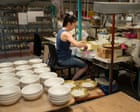
On the floor of Portmeirionâs factory in Staffordshire, staff are hard at work as clays are moulded, glazed and fired â an intricate process requiring precision and specialist skills honed over years of practice â to manufacture the companyâs array of tableware.
Portmeirion, a homeware brand founded in 1960 that employs 433 people, is based in Stoke-on-Trent, at the heart of British ceramics. The centuries-old craft is so integral to the areaâs identity that the six federated towns that make up the Staffordshire city are known as the Potteries.
âAll my family were in the industry,â says Sam Pearce, the companyâs chief operating officer. âItâs a really important part of the heritage of the city.â
The UK ceramics sector employs 20,000 people, half of them in the West Midlands, and is regarded as an indispensable to the economy. Not only does it manufacture household essentials such as crockery, bathroom fittings, tiles and bricks, but also defence, security and technology components ranging from microchips to missiles.
But this national heirloom is starting to crack as it suffers the blows of international competition, rising labour expenses and the soaring cost of energy, which leapt after Russiaâs invasion of Ukraine and has again been driven up by the US-Israeli conflict with Iran.
Illustrious names in the region have gone under or are teetering on the brink. In February last year, Royal Stafford went bust after nearly 200 years and Heraldic Pottery closed the same month.
The world-renowned Wedgwood was forced to freeze production at its factory for 90 days, only restarting in January, and Derbyshire-based Denby, established in 1809, called in administrators on 31 March, with the group blaming escalating employment and energy costs.
âThe sector as such has been under huge pressure â thereâs no denying that,â says Michael Scheepers, Portmeirionâs recently appointed chief executive. âI think everybody who has seen recent news of companies struggling and brands disappearing over time can see how it has impacted the overall sector.â
The chancellor, Rachel Reeves, said the industry underpinned âour economic resilienceâ when she announced a £120m support package to support energy efficiency, decarbonisation and long-term competitiveness last month. The trade body Ceramics UK will work with civil servants on the design and implementation of the scheme.
Rob Flello, the chief executive of Ceramics UK, says rising energy costs are central to the financial difficulties. Production processes require prolonged firing temperatures typically above 1,000C, but the cost of gas to power furnaces has soared, with UK month-ahead prices hovering around 118p a therm â 50% up on the 78.50p the day before the Iran war began.
However, he argues high prices have been compounded by the governmentâs target to reach net zero emissions by 2050.
That policy, championed by the energy secretary, Ed Miliband, came under fire in Tony Blairâs wide-ranging attack on Keir Starmerâs government last month. The former prime minister urged the government to âprioritise cheaper energy and electrification over net zero and use what is left of our North Sea oil and gasâ â an intervention criticised as âbizarreâ by experts in the face of energy and climate crises.
However, it appears to resonate with some ceramics-sector leaders. âItâs no good us being zero carbon [in the] UK in 2030 if thatâs because we donât manufacture anything in the UK,â Flello says. He wants the government to âdecarbonise sensibly rather than decarbonising by deindustrialisation, which is the path weâre on at the momentâ.
âEnergy is much much more expensive in the UK than in competitor countries,â he adds. âOur brickmakers pay effectively a carbon tax under the UK emissions trading scheme. Imports from Turkey, China and India donât have to pay carbon tax. So the odds are very much stacked against British industry.â
Alex Patrick-Smith, the executive chair of Dreadnought Tiles, a brick and clay roof tile manufacturer based in the West Midlands, agrees, saying Blair is âpushing the right buttonsâ and the current targets on net zero are ânot realisticâ.
âIâm a great supporter of decarbonising. I do see global warming as a big threat,â he says, but adds: âWeâve lost a lot of our supply chain in our industry. The number of businesses that are left are dwindling in our industry and it just comes to a point where youâve just got to stop.
âThis is strategically important for the country ⦠If things get really tough in the geopolitical world and you canât repair your bridges because you canât make engineering bricks in this country any more, youâre expecting to import them from overseas. In doing so, all youâre doing is exporting your carbon to somewhere else â itâs not improving the global situation.â
Flello says the ceramics industry is committed to decarbonising and has spent £750m on initiatives to do so, but it is inherently energy hungry and therefore one of the hardest to wean off fossil fuels.
Patrick-Smith says his company has spent âhundreds of thousandsâ on energy efficiencies, including kiln upgrades and a heat recovery scheme. However, he says many of those investments were âeye-wateringly expensive and the returns are just not thereâ.
In the hopes of addressing rocketing energy costs, all three industry leaders called on the government to extend eligibility to the British Industry Supercharger and British Industrial Competitiveness Scheme (BICS) â which provide relief from electricity costs for firms in areas such as steel and chemicals.
When Reeves beefed up the BICS scheme in April in response to Iran war pressures, expanding the number of firms covered to 10,000, ceramics companies asked why they had been left out. Nearly 90,000 people have since signed a petition asking for the sector to be included.
A government spokesperson said: âManufacturing industries like ceramics are vital to the UKâs success and essential for growth, but we recognise the challenges they are facing, including on the cost of energy.â They highlighted the £120m support already announced for the sector, adding: âWe continue to work closely with the industry to ensure weâre doing what we can to help them through tough times.â
Ceramics are not only fundamental the UKâs economic resilience, the industry leaders argue, but also to the heritage and economy of the West Midlands.
Flello, who was a Labour MP for Stoke-on-Trent North from 2005 to 2017, says: âThere was a saying locally that you either work in the pits or the pots. Pretty much everybody you knew worked either in one of those two.
âOver the last 50, 60 years, the industry has dramatically contracted â rather than every town now having a brickworks there are probably about 36 across the UK.â
Yet despite such decline, the industry still has passionate backers. The heritage brand Moorcroft returned to production in September after being saved from liquidation by the grandson of its founder. And this week rumours were swirling of a possible rescue for Denby, after Sky News reported that Home Bargains, one of the UKâs biggest homeware retailers, was pursuing an acquisition for its name and other assets.
Scheepers says Portmeirion is determined to increase its production in the UK: âIf we have clear, targeted support, I think that would be invaluable.â
Flello also says that, despite the challenges, there are glimmers of hope. In particular, he says Reevesâs support package could be the springboard to signal âthe industry can stop declining and start growing againâ.
He says: âThere is definitely hope and with the £120m thatâs probably the greatest cause of optimism. It all depends now on how the programme is put together. It does need some other things coming in behind it, but this is really a positive development.â