âGörli is our gardenâ: Berliners fight to stop mayor locking their park at night
Kreuzberg campaigners win court ruling against â¬2m fence aimed at shutting out drug dealers
The âhollowâ in Görlitzer Park was heaving with revellers who had gathered in reaction to a court ruling against Berlinâs mayor who wanted to lock it up at night. âGörli is our garden,â said Monika, a retired psychiatric nurse who lives nearby and had joined the crowds on Monday night for a beer and a bop on the popular deep bowl-shaped meadow in the Kreuzberg district.
âGörli is where we socialise and where my daughter grew up,â she said, using the affectionate nickname for the centrally located green space covering 14 hectares (35 acres).
A decades-long on-off row about the parkâs patrons and its role in Berlinâs daily life resurfaced earlier this year when the state government voted to seal it with a perimeter fence overnight in order to squeeze out the drug dealers and addicts who proliferate there.
âWe must, in the literal sense, take back control of Görlitzer Park,â the mayor, Kai Wegner, declared in 2023 after a âsecurity summitâ.
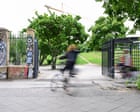
After much deliberation, a metal fence with 16 gates, installed at a cost of about â¬2m (£1.7m), became operational on 1 March. After the ruling on Monday, the fence has stayed up but the gates have remained open 24/7.
Few deny the problems attached to drug dealing â families report finding syringes and human faeces in playground sandpits and women say they have been abused.
But âa fence doesnât solve any problems, it just moves them elsewhereâ, said Monika, a member of Görli Zaunfrei (Görli Fence-Free), one of several groups that campaigned against the fence and are calling for a more integrated, sustainable and better-funded plan to tackle the parkâs challenges.
Mondayâs court ruling came as a blow to Wegner, of the conservative Christian Democrat party, who faces an election in September that he has billed as referendum on his promise to clamp down on crime in the German capital.
In Kreuzberg, a culturally diverse and bohemian neighbourhood, parts of which have rapidly gentrified, he is disparagingly referred to as the âZaunkönigâ (fence king).
âHe himself has nothing to lose in Kreuzberg, where the CDU hardly stands a chance politically,â said Judith, a teacher and, like Monika, a member of Görli Zaunfrei.
The park has long been at the centre of wider culture war debates in Germany, to the extent that most Berliners â and many beyond â have an opinion about it even if they have never set foot in it. As Judith put it: âA fence around Görli was never anything more than symbol politics â an election campaign gift for CDU voters in the suburbs.â
As opponents of the fence predicted, illicit activity has been pushed into neighbouring areas, where there are reports of drug users being found sleeping in the stairwells and doorways of apartments and kindergartens.
Many of the Berliners interviewed by the Guardian in the park this week â from people watching their grandchildren at a play day to a group singing campfire ballads â said they would rather the â¬2m, and estimated annual security costs of â¬800,000, were used to tackle addiction and related issues.
Residents and local politicians complain that resources for drop-in drug centres, social workers and drug consumption rooms have been frozen or cut back.
One of the legal headaches faced by Wegner is that by erecting the fence, he has ruled against the will of the district council responsible for the space. âIt reminds us of Trump in California â going over the heads of those in power there, to assert his law and order,â said an elderly woman walking her chihuahua at dusk. She spoke of her frustration at being forced to curtail âwalkies at dawnâ.
Long-term residents say the spirit of the community campaign is reminiscent of clashes between police and Kreuzbergers in the 70s and 80s, when squatters campaigned with considerable success to save the elegant period buildings that surround the park from being bulldozed.
At the height of what has often been a high-spirited campaign to remove the fence, activists dressed as Easter bunnies handed out copies of the master keys to locks on the fencing, which actually worked, and offered tips on the whereabouts of gaps where they said ânight-time hoppersâ could enter the park.
In response to supporters of the fence who have asked why the park needed to stay open late at night, an older, blind man said it intersected with several residential streets and that its closure forced pedestrians and cyclists to take significant detours along routes that were often poorly lit. He described Görli as his âvital shortcutâ from the stop where the night bus dropped him off to his flat.
Wegner has said the senate will appeal against the interim ruling, which could be reversed. Monika said: âWe are making the most of the situation in the meantime.â
She and Judith, who met through their campaigning and are now friends, said one good aspect of the fence was that it had brought the community closer together. They are now on a crusade to pull down the parkâs boundaries altogether, Judith said, so that âpeople can go in and out whenever they like and no one needs to feel scaredâ.