Museums across North America hope to score with World Cup programmes
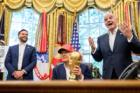
Game plan: US President Donald Trump, with Vice President J.D. Vance (left) and Fifa President Gianni Infantino at The White House with the famous World Cup globe trophy Photo: Daniel Torok/The White House
Relations between Canada, Mexico and their mutual neighbour the US are more fraught than at any time in recent memory. The Canadian prime minister, Mark Carney, has positioned himself as a bulwark against US President Donald Trump’s threats of annexation, while the Mexican president, Claudia Sheinbaum, has weathered Trump’s pressure on issues ranging from migration to drug cartels. But ahead of the 2026 Fifa World Cup (11 June-19 July), institutions in cities across all three host nations are engaging in some jocular football diplomacy and taking a shot at sports-themed programming to break down political and cultural barriers.
In March, the Pérez Art Museum Miami (Pamm) opened its version of the San Francisco Museum of Modern Art-originated exhibition Get in the Game: Sports, Art, Culture (until 23 August) with a two-day conference on the ways that sports and culture intersect. Organised with the New York-based marketing firm Cultural Counsel, “Game Time” brought in artists, athletes, curators and other cultural voices for a series of panel discussions, film screenings, readings and other programmes.
This was no place for softball topics, though. The artist Hank Willis Thomas, for instance, discussed a work of his from Get in the Game, a quilted, scale replica of Pablo Picasso’s Guernica (1937) made from professional basketball and American football uniforms, recontextualising the painter’s anti-war epic to frame sports as sublimated combat. Thomas noted the militaristic origins of competitions like the Olympics as training for war, the violent nature of sports-related expressions (“we beat them”) and the uneven power dynamics of labour and profit in the field. “A lot of the people who are fuelling these multi-billion-dollar industries are the descendants of slaves and sharecroppers,” he said.
Installation view of Get in the Game: Sports, Art, Culture at the Pérez Art Museum Miami Photo: Lazaro Llanes
“The spectacle, the way in which our eyes are captivated in the validation of sports, of sports jerseys, is something I’m so in awe of,” Thomas continued. “I can use this material to actually draw people into other stories.”
This wrestling with the weightier side of sports was exactly what the organisers of the Pamm conference had hoped for. For Cultural Counsel’s founder Adam Abdalla, “Game Time” was a means of using sports to covertly approach potentially divisive topics in a time of extreme polarisation.
“No one’s going to try to defund the museum for talking about sports, and I think it gives people comfort at a time when things have been so fraught and so politicised,” he says. “People are really lacking empathy. They’re really detached or disaffected, and there are very few things that get people to get off their phone and come together to have a joint experience with people from any walk of life.”
He adds: “Sports is one of those things. You can go to a ball game and somebody who is a schoolteacher could be sitting next to a billionaire, could be sitting next to a student, could be sitting next to a janitor, and they all can be having the same reaction, high-fiving and it erases that perceived difference of perspective.”
Franklin Sirmans, Pamm’s executive director and the moderator of Thomas’s panel during “Game Time”, echoes Abdalla’s sentiment. The conference “validated the importance of getting together in the same space just to talk”, he says. “When you put artists and people together in the same space to really go deep and talk about what is embedded in the work, we all benefit in some way.”
Installation photo, Fútbol Is Life: Animated Sportraits by Lyndon J. Barrois, Sr., at the Los Angeles County Museum of Art, until 12 July © Lyndon J. Barrois, Sr.. Photo © Museum Associates/LACMA, by Jonathan Urban
Sirmans has a track record of injecting sports into the art world. In 2014 he curated the football-themed exhibition Fútbol: The Beautiful Game at the Los Angeles County Museum of Art (Lacma), timed to that year’s World Cup in Brazil. Lacma is following that precedent with its current exhibition Fútbol is Life: Animated Sportraits by Lyndon J. Barrois, Sr. (until 26 July).
The show centres on Barrois’s replicas of famous moments in football history depicted by miniature models he fashions from gum wrappers and other materials. It features 60 works, including replicas of local soccer stars and the stop-motion film Fútballet (2018). For the exhibition’s curator, Britt Salvesen, it functions as a test run for more ambitious sports-related programming to come during the Summer Olympics in Los Angeles in 2028.
“I’ve been looking at the history of exhibitions around art and sport, and also asking around to try to understand what other places in LA are going to be doing then,” Salvesen says. “That was one of the reasons, apart from believing in Lyndon’s work, that I really wanted to curate this show with him, to use it as a bit of a laboratory to think about the concepts of art and sport and how museums can bring something to that dynamic.”
Installation view of Football & Art: A Shared Emotion, Museo Jumex Photo: Ramiro Chaves
Thinking about original ways to combine art and sport also posed a challenge for the Museo Jumex in Mexico City, where the opening match of the World Cup will be played on 11 June. Due to the difficulty of securing art loans, the curator Guillermo Santamarina opted to commission several pieces from local artists when planning the museum’s World Cup-themed exhibition Football & Art: A Shared Emotion (until 26 July). The resulting show features internationally renowned artists like Wangechi Mutu and Maurizio Cattelan as well as works directly referencing their Mexican context. For instance, Sofía Echeverri’s 2025 embroidery piece Dechado de impedimentos (a paragon of impediments) draws on research the artist conducted on Mexico’s first national women’s football team, which played in the final of the 1971 Women’s World Cup in Mexico City. Another work, by Diego Berruecos, compiles video footage of every penalty kick missed by the Mexican national football team since 1985, which the curator characterises as a national metaphor.
“It gathers the history of all the penalties that were unsuccessful, which meant parallel tragedy for Mexican society, for the whole country. And this relates to our history, our political history, our social history,” Santamarina says. “It’s not just about football. It’s our own national drama.”
Marta Minujín, Mi Mundial (My World Cup), 1977 Colección Fundación Federico Jorge Klemm, Buenos Aires. © Marta Minujín, courtesy of Henrique Faria, New York and Herlitzka & Co., Buenos Aires.
Other institutions have opted to focus on sports-related artefacts for their World Cup-adjacent programmes. The American Museum of Natural History in New York is hosting For the Win: Objects of Sports Excellence (until January 2027), an exhibition of trophies, championship rings and other objects detailing the sports world’s obsession with victory. Olympic medals and torches figure alongside archival objects such as a New York Police Department medal of valour that inspired the New York Yankees baseball team’s logo.
Vikki Tobak, the exhibition’s curator, says the objects in For The Win can be appreciated both for their historical significance and for the unique design elements they incorporate. “We really wanted to tell the story of the craft of these pieces and the artisans who work on them,” she says.
A display devoted to “The Art of Winning” in For the Win: Objects of Sports Excellence, featuring Claressa Shields 2019 WBO Middleweight Championship Belt, the NFL’s Vince Lombardi Trophy, Major League Baseball World Series Commissioner’s Trophy, the NWSL 2023 Championship trophy awarded to NJ/NY Gotham FC, and the MLS Philip F. Anschutz Trophy awarded to New York City FC in 2021. Photo: Alvaro Keding & Daniel Kim/©AMNH
Several objects in the show were made by historic jewellery firms, such as the NFL’s Vince Lombardi Trophy given to Super Bowl winners, which was designed by Tiffany & Co. Tobak also points to a championship ring from the New York Liberty, the 2024 WNBA (Women’s National Basketball Association) champions. Co-designed by Jason of Beverly Hills and the Brooklyn-based studio L’Enchanteur, the piece incorporates black diamonds in reference to the court at the Liberty’s home arena, the Barclays Center, as well as a secret compartment holding a pair of earrings, giving players an alternative to wearing the heavy ring.
Football fans in all three host nations and beyond will anxiously wait to see which team lifts the famous gold trophy on 19 July. In the meantime, these sports-centric exhibitions may just provide relief from the stress of the game—if not from North America’s simmering geopolitical tensions.
Game On!Aga Khan Museum, TorontoUntil 7 September
Del paste al poste. El futbol en MéxicoMuseo del Caracol, Mexico CityUntil 30 September
Football & Art: A Shared EmotionMuseo Jumex, Mexico CityUntil 26 July
Once Upon a FieldMariane Ibrahim, Mexico CityUntil 15 August
Big GoalsReefline, Miami Beach14-28 June
Collection in Focus | Zidane, a 21st century portraitSolomon R. Guggenheim Museum, New York11 June-19 July
Fantasy FutbolHigh Line, New YorkUntil 6 July
For the Win: Objects of Sports ExcellenceAmerican Museum of Natural History, New YorkUntil January 2027
Fútbol Is Life: Animated Sportraits by Lyndon J. Barrois, Sr.Los Angeles County Museum of ArtUntil 26 July
Get in the Game: Sports, Art, CulturePérez Art Museum MiamiUntil 23 August
More Than a MatchArlington Museum of Art, TexasUntil 2 August
Zidane: A 21st Century PortraitThe Bass Museum of Art, Miami BeachUntil 19 July