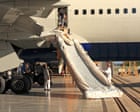
Air passengers ârisking lives by grabbing bags and filming in emergenciesâ
Fines may be needed to deter travellers from retrieving hand luggage, says official from airlines body Iata
Air passengers are increasingly putting lives at risk by filming emergencies and retrieving bags instead of evacuating planes, industry experts have said, with some suggesting fines could be needed.
Passenger aircraft are designed to be fully evacuated in 90 seconds in an emergency â but people reaching for hand luggage can significantly increase that time, blocking exits and aisles as well as damaging slides or causing injury.
The global airlines body Iata has launched a safety campaign urging customers to âsave a life, not a bagâafter a number of evacuations filmed by passengers have appeared on social media, some showing people carrying luggage from burning planes.
Nick Careen, the Iata senior vice-president for operations and security, said the first priority was to educate passengers that it was âmost important to leave hand baggage behind. We need to drive the message home.â
Research on travellers in the UK, US, Singapore and UAE found that only 61% were aware of the rules. âFour in 10 passengers donât even realise itâs an expectation to leave their shit behind,â Careen said, speaking at the Iata annual meeting in Rio de Janeiro.
Asked if he favoured fines, Careen said: âYes, if we could implement them. It could progress because there are regulators who favour it.â
He said airlines and manufacturers were not yet considering potential technical fixes such as automatically locking luggage bins. But Careen said: âLetâs start with education â then weâll have to be a little bit more draconian, whether it be penalties or a lock on the overhead bin.â
The US Federal Aviation Administration (FAA) said it was seeing an increasing number of passengers not following flight crew instructions during emergencies. Bryan Bedford, an FAA administrator, said: âIn those moments, compliance is critical. Passengers must act quickly, follow instructions without hesitation, and leave all belongings behind.â
Evacuations are rare in aviation, with only an estimated 30 annually. Last year at least two-UK bound flights were evacuated on the asphalt before departure after suspicions of fire, with 18 passengers sustaining minor injuries leaving a Ryanair plane at Palma airport last July. Passengers described the evacuation as âutter carnageâ.
Videos of similar events have provoked consternation, both at those stopping to film potentially disastrous events on smartphones and those seen carrying luggage off emergency slides.
Some aviation safety experts, however, suggested the response was understandable. Brett Molesworth, a professor of human factors and aviation safety at the University of New South Wales, said unfamiliar emergencies led to a âfight or flightâ stress response when only a minority of people acted rationally.
For about 75% of people, he said, âtheir ability to process information is restricted. In those circumstances if theyâve got their bag in the overhead lockers they want to take it with them.â
Dr Levi Breeding, a senior auditor at United Airlines, said that while there may be âsome disbelief and disconnection from the situationâ in an emergency, too many in the TikTok generation âhad an instinct to pull the phone outâ, some potentially looking to make money from footage of a newsworthy event.
He said: âEvery day is a struggle getting the message across ⦠Our passengers donât live in aviation safety every day like we do.â
Rachel Loudermilk, the managing director of inflight safety at Southwest Airlines, said cabin crew were having to learn to make passengers comply. She said: âGetting that mindset shift to flip the switch and now yell at them very directly in their face is tough, but thatâs what weâre working on.â
She added: âThereâs an inherent risk in aircraft â but nobody thinks that will happen to them. Or they think that theyâll be OK, even if they take a bag.â
Molesworth said Iataâs campaign featuring cartoon animals might struggle to cut through, as research showed that only about half of passengers who watched safety videos took the information in.
Loudermilk concurred but said: âWe canât lose customers, so weâve got to figure out a way to show them reality without showing dead bodies.â
Willie Walsh, the outgoing director general of Iata, said he did not favour fines. But he said he still vividly remembered the Manchester airport disaster in 1985, when 55 people died, mainly of toxic smoke inhalation, after a botched evacuation. He said: âWe donât take decisions to evacuate aircraft lightly â so if does happen, get off,â he said.
Flights to the Iata summit were provided by Iata and Latam airline