Kaleidoscopic Subway Mosaics Celebrate Flatbushâs Theater History
At the Church Avenue station, Christopher Myersâs glass-tiled panels explore the rich legacy of vaudeville and Afro-Caribbean carnival culture.
Most people have heard of Broadway or Manhattanâs Theater District, but in new mosaics at a Flatbush subway station, artist Christopher Myers celebrates a Brooklyn neighborhoodâs equally rich performing arts legacy.
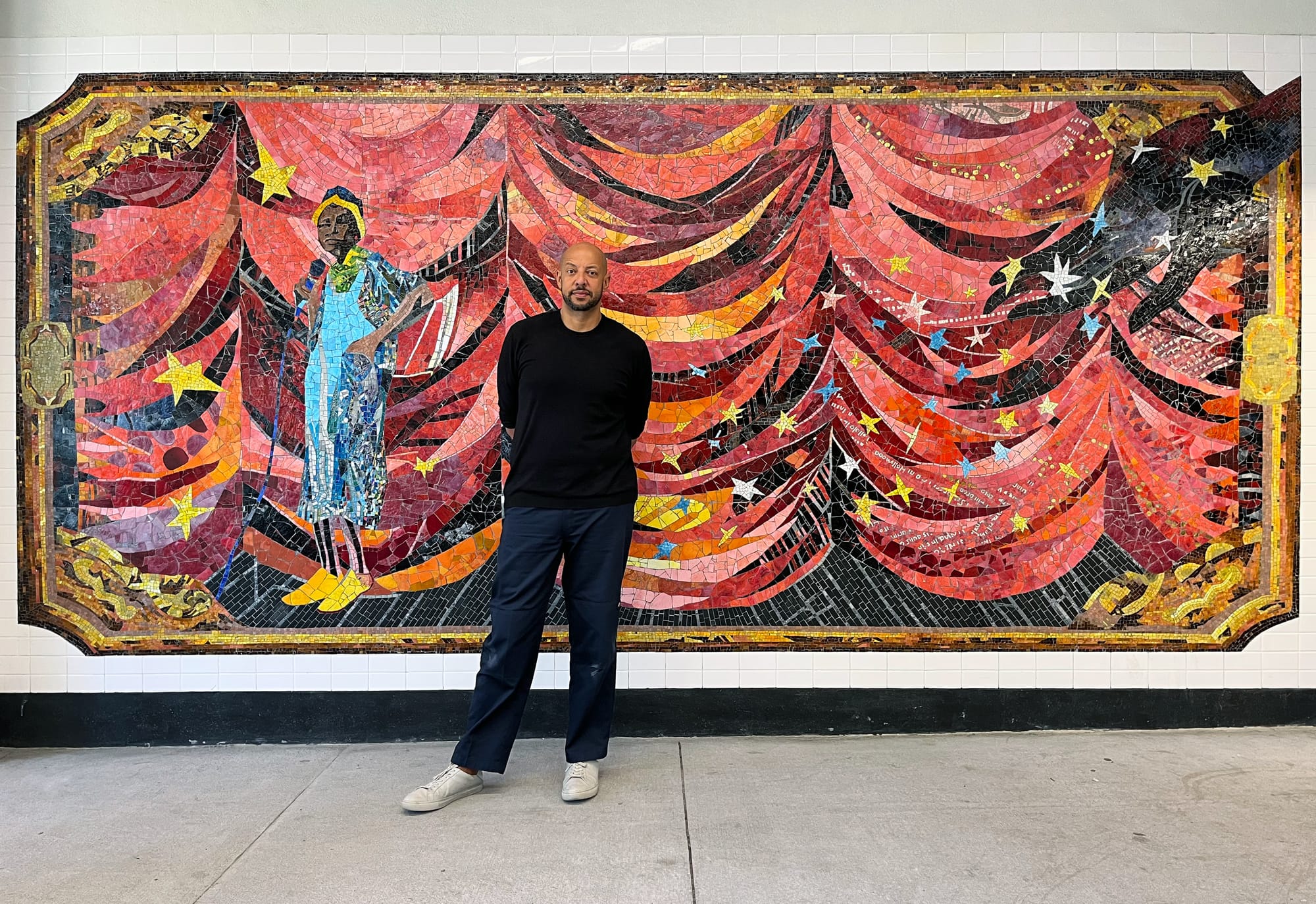
Each day, more than 10,000 people encounter Myersâs four glass-tiled panels, titled âIf you don't want your children to know the truth about life don't send 'em to the theater,â unveiled in March at the Church Avenue subway station.
The Queens-born artist has created large-scale tapestries and sculptures that have been exhibited at museums and galleries around the world. But his subway piece, the first mosaic of his career, received a different level of attention.
âIâve shown at the Guggenheim and Studio Museum, but this is the most democratic space I will ever get to share my work,â he told Hyperallergic. âIâve come here and talked with young kids, and theyâre curious about the figures in the work. Theyâre trying to find out who they are.â
The four panels are among the latest additions to the Metropolitan Transportation Authorityâs (MTA) Arts & Design collection, a 40-year-old program comprising nearly 400 public artworks scattered throughout its subway and commuter railroad stations.
Whenever the MTA renovates a station, the agency sets aside one percent of the projectâs budget for a permanent art installation. Each artwork must fit the stationâs design parameters while also reflecting the artistic and historical legacy of the surrounding neighborhood.
The MTA commissions roughly 10 new works each year, but the process can be highly competitive. After issuing an open call for the Church Avenue stationâs wall locations in November 2023, the MTA received 306 submissions, then culled the proposals to 37 before selecting four artists to present their vision to a panel of local arts and civic leaders last February.
Myersâs idea stood out from the beginning. He spent three months researching the cultural history of Flatbush, learning about its turn-of-the-century vaudeville scene and the Afro-Caribbean migration to Brooklyn in the 1940s and â50s.
âWhat I discovered was the thread of Flatbush as a theater district which needed to be resurfaced as an unsung history,â he said. âThereâs also the idea of the subway itself as a kind of theater for the public.â
The mosaics feature six figures inspired by Afro-Caribbean carnival traditions, including stilt walkers seen in Brooklynâs West Indian Day Parade, as well as Flatbushâs own stage performers. The most prominent character is Moms Mobley, the North Carolina-born stand-up comedian Loretta Mary Aiken, who performed in traveling Black vaudeville shows before making appearances to wider audiences in the 1960s on The Ed Sullivan Show and The Smothers Brothers Comedy Hour.
Myersâs mosaic positions Mobley in the middle of her act on the left side of a stage in front of a red velvet curtain bedazzled with stars and a giant outstretched hand, a reference to a Hungarian immigrant artist who painted several of the cityâs theaters.
The panel was impressed with the depth of Myers's research, how he connected it with contemporary expression of art across multiple generations, and his use of the space within the station.
âWe want to interrupt the ordinary with moments of pause, connections, and beauty, and Chrisâs work does that so well,â said Tina Vaz, director of the MTAâs Arts & Design program. âIt really celebrates the creative dynamism of the Flatbush community over time. He created this joyful celebration of community, memory, identity, and storytelling, which exemplifies what we hope to do across our work.â
Myers worked with Mosaicos Venecianos de México, a Cuernavaca-based fabricator, to design, manufacture, and ship the panels to Brooklyn. The process took 13 months to complete and about two weeks to install.
Now Myers is part of one of the nationâs most esteemed public art collections, which includes works by Sol LeWitt, Roy Lichtenstein, Romare Bearden, and Yoko Ono. The experience of working with the MTA has inspired him to design four additional mosaics for institutions including the Crystal Bridges Museum of American Hart in Arkansas and the Johns Hopkins School of Public Health in Maryland.
But Myers remains viscerally connected to the subway. He remembers seeing art in stations taking the train from his home in the LeFrak City apartment complex where he grew up in the 1970s and â80s. One of his fatherâs poems was also included in the MTAâs Poetry in Motion program, which posts poems inside its train cars.
âWhen you go to other subway stations youâre surprised by how many different choices artists make,â he said. âNew York is the only 24-hour subway system. Itâs so much a part of our everyday life.â