US releases text of Iran peace plan as Trump says deal averts âworldwide depressionâ
Details of 14-point MOU revealed as senior US officials claim âmajor winâ despite significant concessions to Tehran
The Trump administration has released the text of its 14-point agreement with Iran, claiming it delivered a âmajor winâ for the United States â even as it made significant political and financial concessions to Iran to reopen the strait of Hormuz and prevent a âworldwide depressionâ.
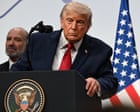
In extraordinary remarks on Wednesday, Donald Trump went from threatening Iran with a new wave of attacks to suggesting the country had basic rights to enrich uranium for civilian use, that he would not pressure Tehran to abandon its ballistic missiles programme and the US was âgoing to have to give backâ billions of dollars in frozen Iranian assets.
Those remarks, as well as the full text of the agreement â which was hailed by Hezbollah chief Naim Qassem as a âgreat victoryâ â are likely to fuel anger in Israel and among hardliners in the Republican party who had urged Trump not to make a deal with Tehran.
Defending the deal, Trump said no US president had ever been as tough on Iran as him, and âthere is nothing as smart as the market â and the market loves itâ.
Trump said that âthe alternative would be a worldwide depressionâ, arguing that if he had not struck a deal, âthe strait [of Hormuz] would never have been opened. They donât like floating billion-dollar ships up and down the strait when their rockets are flying overhead and there are mines all over the place.â
Senior administration officials, meanwhile, said the deal would help prevent Iran from obtaining a nuclear weapon, pointing to an agreement to discuss down-blending its 440kg stockpile of highly enriched uranium, which could be further enriched for use in a nuclear weapon. Trump has said he was open to the stockpile being diluted inside Iran under the supervision of the International Atomic Energy Agency.
âAt a minimum, the enriched stockpile will be destroyed by down-blending,â said the senior administration official who read the text of the agreement. âWe will push for more than that, but the fact that theyâre conceding to that is a major, major win for the United States of America.â
Trump said the deal to end the months-long conflict, which has cost thousands of lives and devastated the world economy, would formally be signed âshortlyâ, adding it could take place on Thursday or Friday.
Iran had suggested that the deal could be signed by Trump and Iranian president Masoud Pezeshkian, in what would mark the highest-level meeting between the two countryâs leaders since the diplomatic break of the 1980s. Initially, vice-president JD Vance was expected to sign the deal at a formal ceremony in Geneva on Friday.
The Trump administration had delayed the release of the full text of the memorandum of understanding, which is essentially a 60-day ceasefire agreement, in order to hold more comprehensive nuclear and permanent peace talks with Iran. The 14-point plan was dictated to journalists during a background briefing by senior administration officials as Trump spoke at the end of the G7.
The deal would provide important financial incentives to Iran, including the immediate lifting of a US naval blockade on Iranian ports and the issuance of waivers for Iranian crude to be shipped abroad, as well as the potential lifting of all international sanctions against Iran, the unfreezing of billions of dollars in Iranian assets and plans to develop a $300bn (£224bn) reconstruction fund for Iran funded by regional partners in the Gulf.
Trump angrily rejected suggestions that the US would be contributing to the $300bn investment fund for Iran, instead saying payouts by Gulf states were likely to be conditional on Iranâs good behaviour.
âAnyone who wants to can invest. What do you expect me to say: no one is allowed to invest? But weâre not investing; weâre not putting up even 10 cents,â he said.
The ceasefire deal included Lebanon, a key Iranian demand, which would restrain Israel from conducting military operations in the country, according to a senior administration official. It also included a clause ensuring the âterritorial integrityâ of Lebanon, although an administration official when asked did not confirm that meant Israel would be forced to withdraw from the swath of the country it has occupied as a âbuffer zoneâ against Hezbollah.
In return, Iran would allow the toll-free passage of ships for 60 days through the strait of Hormuz, a conduit for 20% of the worldâs global oil supply, would agree to restrain its foreign allies including Hezbollah in Lebanon, and âreaffirms that it shall not procure or develop nuclear weaponsâ, with plans to hold nuclear talks including the down-blending of some 440kg of highly enriched uranium that is near weapons-grade.
Iranâs official news âagency released âdetails of âthe deal planned to be signed âon Friday, shortly after a US official released a copy of the text.
Details published by IRNA included US âcommitments to grant Iran access to its frozen âfunds and end the blockade on its ships and ports while Iran commits to â facilitate the return of marine traffic âin âthe Gulf âand Gulf of Oman âto âprewar levels âand not âto produce or acquire nuclear weapons.
Tehranâs foreign ministry said it was considering a plan for the presidents of the US and Iran to sign the deal ahead of an expected ceremony in Switzerland.
Trump backed a G7 leadersâ joint statement that welcomes the deal but says a follow-on agreement is necessary to rein in Iranâs ballistic missile programme, an issue not directly addressed in the memorandum of understanding.
âThey have to have some, because other people have some,â Trump said. âYou got to have some.â
âWhat am I going to do? Am I going to let Saudi Arabia have missiles, but they canât have them?â he added, referring to previous discussions with advisers on Iranâs missile arsenal.
Franceâs president Emmanuel Macron called it a âvery good dealâ, adding that US allies in the G7 support it âbecause itâs an agreement that puts a stop to a situation of great instability that had terrible consequences for our economiesâ.
But the G7 proposal for further talks involving European leaders about Iranâs ballistic missiles and support for proxy forces is bound to be rejected by Iran. Tehran has been negotiating exclusively with the US and regards Europe as largely irrelevant.
Iran is also likely to reject France and Britainâs plan for a taskforce to escort ships through the strait of Hormuz, a proposal endorsed in the G7 leadersâ statement.
The G7 leaders said the agreement provided âan historic opportunity to prevent Iran from acquiring any nuclear weapon and tackling the threats related to its regional and ballistic activities. We support and are ready to contribute to its implementation.â
Reaffirming the right of transit passage without restrictions or tolls as a bedrock of international trade, the leaders said: âThe multinational, independent and defensive initiative led by France and the UK can play an important role to facilitate the resumption of maritime traffic in the strait of Hormuz.â
Trump also sounded a conciliatory note on returning frozen assets to Iran, a stipulation of the Obama administrationâs Joint Comprehensive Plan of Action that he had attacked in 2015.
âWe have taken a lot of their money,â Trump told reporters. âItâs not our money, itâs their money, and we froze it at a certain point in time. I guess weâre going to have to give it back, you know, if we didnât give it back, nobody would ever invest in the dollar again.â
Trump claimed the price of oil per barrel had fallen to $72 â Brent crude dipped below $80 on Tuesday â and would soon fall below the level it had been at before the war.